Math · Grade 1–2 to Grade 7–8
The Pet's shop
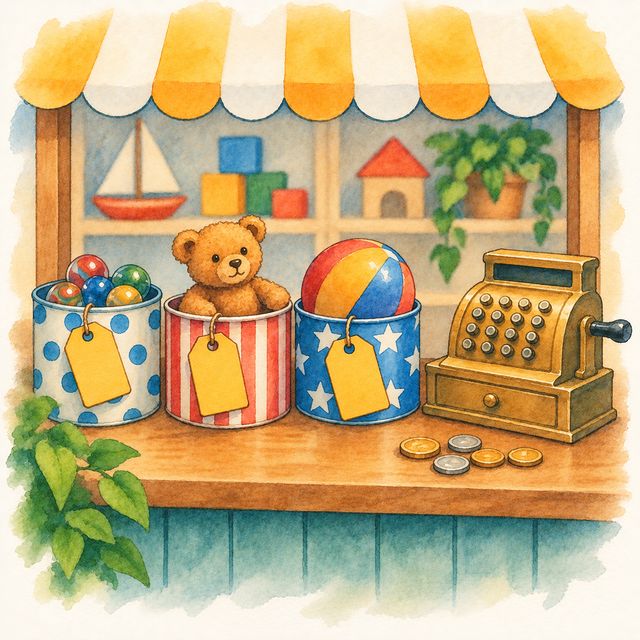
Money maths that buys something real for the Pet's room.
The Pet wants something for its room, like a hat or a lamp, and says the price. Your child pays with coins, later works out change, sale prices and the better buy, and the thing appears in the Pet's room.
- Grade 1–2 to Grade 7–8
- 10 min
- Nothing to prepare
- On the screen
Free to sign up.
Is it a good fit?
- Ready if Your child knows your family's smallest coins and can count up to a small price.
- Too much today? Start with Make the amount: making an amount with coins before buying with them.
- Too easy? The Grade 7–8 level: which pack of Pet food is cheaper per gram, then three things inside a budget.
What your child practises
- Paying an exact price
- Working out change
- A sale and the tax
- The better buy
“You gave me 10 cents short, I counted.”
If your child says something like this, in their own words, the idea has landed. Finishing the rounds means they took part; this is the learning.
Your part
- Nothing to prepare or print
- Each question has a Read it to me button
- Plays alone: too much or too little gets a question, never a cross
Take it off the screen (optional)
Lay each price out on the table with your family's real coins.
More like this
The full design
What it is
The Pet runs a little shop of things it wants for its room: a hat, a plant, a lamp. Your child pays, and the thing appears in the Pet's room. That is the whole reward, and it is earned by the maths: counting coins to a price first, then working out change, then a sale price and the tax, then which pack is the better buy. Money is the one place a child meets counting, subtraction, percent and ratio for a real reason.
How it goes
The Pet says what it wants and the price. Your child taps coins from the tray onto the counter (a tap on a coin on the counter takes it back) and taps Pay. Too little, and the Pet asks "is that more or less than the price?"; too much, "take one back". Exact, and the Pet counts the coins up aloud and the thing goes into its room. At the older rungs the answer is a tap on one of four amounts, and a wrong one gets a reason, never a cross. Three purchases, then a card that says what was done.
The Pet
Notices: "two fives instead of a ten, that works too." Asks on a miss: "is that more or less than 60 cents?" Remembers: "you paid 35 cents for the hat; the plant is 60 cents, is that more?" Admits it was wrong when your child catches the short change: "you caught me, 10 cents short, thank you for checking." Dares: the next kind of shopping.
By band
1–2: pay the exact price with the four smallest coins on the counter, three things to buy. 3–4: pay with a whole coin or note that is too big, say how much change comes back, then check the Pet's counting: once in three it is short, and your child has to catch it. 5–6: a sale, 20% off, and then the tax the way your country does it, added at the till or already in the shelf price. 7–8: two packs of Pet food, which is cheaper per gram; then three things for the room inside a budget.
What it grows
The coins are the maths, not a wrapper around it: moving a real amount to a real price is what makes the numbers mean something, and a reward that grows out of the work itself keeps the work honest.
Done, and what counts as evidence
Done = three purchases. The room is the reward and it is tied to the maths, not to time spent. Nothing is scored. What a parent may note: whether your child counts the coins up in order, and at the older rung whether they check a count instead of trusting it.
What's personal
The coins, the symbol and the tax are your family's, from the country in your settings, so a child in Toronto pays in quarters and a child in Amman in fils. The things bought stay in the Pet's room, which is the child's own.