Science · Kindergarten to Grade 5–6
A cardboard dinosaur
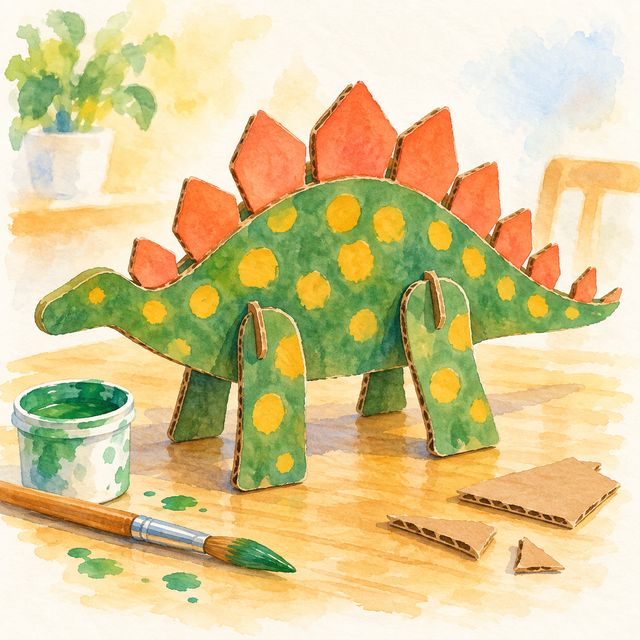
A cardboard stegosaurus that stands on its own.
Your child makes a stegosaurus from a shoebox: a body and two leg pieces slotted across it so it stands on its own, and painted. The screen shows one step at a time and asks what was hardest at the end.
- Kindergarten to Grade 5–6
- 40 min
- A printout
- On the screen
Free to sign up.
Is it a good fit?
- Ready if Your child can paint and push a piece into a slot, with a little help.
- Too much today? The Kindergarten level: you cut the pieces and the slots, and your child paints, fits the leg pieces and stands it up.
- Too easy? The Grade 3–4 level: your child cuts the slots too, and it must stand on its own for ten seconds.
What your child practises
- Following steps
- Cutting and fitting
- Testing and fixing
“I made the leg pieces wider, and now it stands.”
If your child says something like this, in their own words, the idea has landed. Finishing the rounds means they took part; this is the learning.
Your part
- Gather a big shoebox, blunt scissors, a pencil, paper, paint and newspaper
- At Kindergarten you cut the three pieces and their four slots beforehand, and at Grade 1–2 you cut the slots
- More than one sitting: the make comes back at the step it stopped on
What you need
From home
- A big shoebox, opened flat
- Blunt scissors
- A pencil
- Paper for the shapes
- Paint and a brush
- Newspaper, to paint on
- A craft knife (a grown-up's)
The steps
Kindergarten
 Look at the cut pieces: one body and two leg pieces. Each leg piece is two legs joined at the top. Lay them out.
 Look at the cut pieces: one body and two leg pieces. Each leg piece is two legs joined at the top. Lay them out.
The other 4 steps, each with its painting, are in the Family portal.
Grade 1–2
- Draw on paper a body two hands long, with head, tail and back bumps, and a leg piece: a square, one hand each side, a two-finger arch to its middle.
 Draw on paper a body two hands long, with head, tail and back bumps, and a leg piece: a square, one hand each side, a two-finger arch to its middle.
The other 5 steps, each with its painting, are in the Family portal.
Grade 3–4
- Draw on paper a body two hands long, with head, tail and back bumps, and a leg piece: a square, one hand each side, a two-finger arch to its middle.
The other 5 steps, each with its painting, are in the Family portal.
It must pass: It stands on its own for ten seconds.
Grade 5–6
- Design on paper a legless body and a leg piece: two legs joined at the top. Cut them out. Trace them onto the cardboard: body once, leg piece twice.
 Design on paper a legless body and a leg piece: two legs joined at the top. Cut them out. Trace them onto the cardboard: body once, leg piece twice.
The other 4 steps, each with its painting, are in the Family portal.
It must pass: Planned on paper first, it stands on its own for ten seconds.
Safety
The craft knife is yours at every grade this make has: at Kindergarten you cut the three pieces and their four slots beforehand, and at Grade 1–2 you cut the slots. Each slot is two cuts side by side, as far apart as the card is thick, with the strip between taken out, and goes a third of the way in; a leg piece's slot cut much further meets its arch and the piece falls in two. Your child uses blunt scissors, which cut a shoebox's thin card; a corrugated box is too thick for them, so with one you cut the pieces too.
Where the facts come from
More like this
The full design
What it is
A stegosaurus cut from a shoebox as three pieces, a body and two leg pieces, each leg piece two legs joined at the top. Each leg piece slots across the body like a plus sign, so the two of them make four legs and it stands on its own, and then it is painted. The screen gathers the things, shows one step at a time as a painting of that step, and asks at the end what was hardest. Nothing on the screen is the make. The dinosaur on the table is.
How it goes
One step fills the screen: the painted plate of that step, the words under it, and two buttons. Done this step moves on. Too hard, skip it also moves on, and the finish says how many were skipped without dressing it up. At the end, Show asks what is true about the thing made (it stands, it is green with spots, it fell over then stood), and What I learned asks the band's question. At K that question is what was hardest, and waiting for paint to dry is a real answer.
The Pet
Asks at each step, in the fewest words that get a hand moving: "Across the body, like a plus. Push the slots together." Notices the step done: "In. Two leg pieces, four legs." Remembers across a pause: the make comes back at the step it stopped on. Dares at 3 to 4 and up: make it stand for ten seconds. It never hurries the child and it never says a skipped step was a failure.
By band
K: you cut the three pieces and their four slots beforehand (a body about 25 cm long, and two leg pieces about 12 cm square, each with an arch cut up from the middle of its bottom to halfway); your child lays them out, paints the body lying flat, adds spots and plates, pushes the leg pieces on and stands it up. 1 to 2: your child draws the two shapes on paper, sized by their own hand, traces them onto the card and cuts them; you cut the slots. 3 to 4: your child cuts the slots too, and the must arrives: it has to stand on its own for ten seconds, so a fall means one change and another try. 5 to 6: the dinosaur is designed on paper first, and then made.
What it grows
Making with the hands carries what a screen cannot: a slot cut too thin teaches the thickness of cardboard in one go. The step-by-step card, the named materials and the question at the end are how museum and school workshops run a craft, and the shift from craft to project is the shift from following to testing.
Done, and what counts as evidence
Done = the steps done or honestly skipped, and one line chosen at the end. The evidence is the dinosaur, and at 3 to 4 and up the change that made it stand: wider leg pieces, deeper slots, a third leg piece. That is a test with a result, which is worth more to a record than the number of steps.
What's personal
The colours, the spots or stripes, and what was hardest are your child's own and are stored as their answer, not as a mark. Nothing about your home, your table or your materials is stored. A material you do not have is named once, a substitute is offered, and the make carries on.