Science · Kindergarten to Grade 3–4
The nest (dinosaurs)
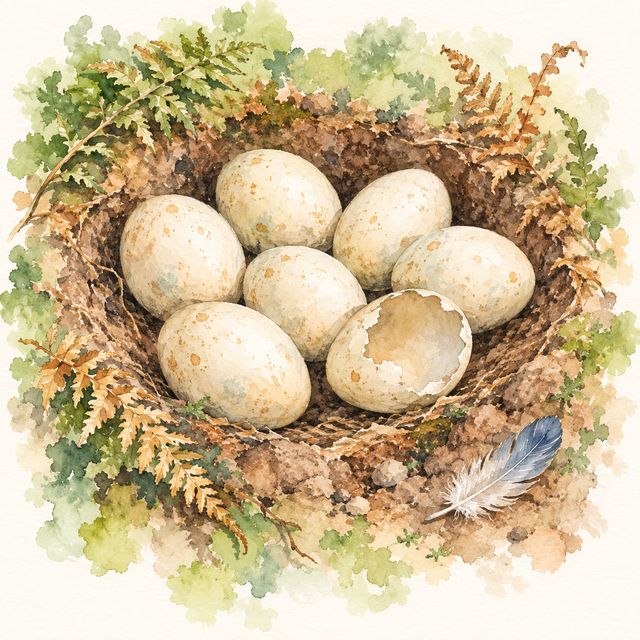
From a dinosaur's nest to the birds outside your window.
Your child counts the eggs in a dinosaur's nest, then picks out the other animals that hatch from eggs. It ends with the birds outside your window, which are living dinosaurs.
- Kindergarten to Grade 3–4
- 15 min
- Nothing to prepare
- On the screen
Free to sign up.
Is it a good fit?
- Ready if Your child can count eggs out loud, touching each one.
- Too much today? The Kindergarten level: count the eggs, then find the animals that hatch from an egg.
- Too easy? The Grade 3–4 level: two findings from the baby bones, and what they mean.
What your child practises
- Counting eggs
- Who hatches from an egg
- Reading what the bones say
“The birds outside are living dinosaurs.”
If your child says something like this, in their own words, the idea has landed. Finishing the rounds means they took part; this is the learning.
Your part
- Nothing for the screen; paper strips or grass to build a nest at Grade 1–2
- Each question has a Read it to me button
- Play together at the table; the walk to look for a nest is yours to take
Take it off the screen (optional)
Take the Pet's dare: look for a real nest this week in the garden or the park, and do not touch it.
More like this
The full design
What it is
Maiasaura built a bowl nest in the ground and laid a clutch of eggs in it, and the babies stayed in the nest after hatching while the parents brought them food. Your child counts the eggs, meets the others that hatch from eggs, and lands on the line the whole strand is for: the birds outside your window are living dinosaurs. It starts as counting and ends somewhere your child can walk to.
How it goes
The nest fills the screen with its eggs in it. At K a tap on each egg counts it out loud, and the count is the round. Then six animals, and a tap on each that hatches from an egg, with the Pet asking about the odd one rather than marking it wrong. At 3 to 4 the round is two findings and one question, and the answers are sentences your child picks between, one of which is a fact that is true but explains nothing, because telling those apart is the skill.
The Pet
Asks "who fed them?" and lets the silence sit. Remembers a nest your family has seen, or frogspawn, and brings it back here. Notices the counting. Admits at 3 to 4 that nobody watched a Maiasaura feed anything: this is what the bones make likely, which is not the same as seeing it. Dares: find a real nest this week, and do not touch it.
By band
K: count the eggs in the nest, then tap the ones that hatch from an egg out of six animals, three of which do not. 1 to 2: build a nest, really, from grass or paper strips, and put something egg-sized in it that will not roll out; then the comparison, a bird's nest in a tree against a bowl scraped in the ground, and why each is where it is. 3 to 4: the evidence round. The bones found in the nests were of babies too big to be newly hatched and with worn teeth, so they had stayed and they had been fed. Your child is shown the two findings and says what they mean before the Pet does.
What it grows
Maiasaura's nests, the clutch of up to about twenty eggs the size of ostrich eggs, the bowl about two metres across, and the babies staying roughly two months while parents brought food are the sourced facts this game is built on, and they are the ones a child can hold. The line that ties it to the garden is that birds are living dinosaurs, which is also the honest answer to "are they all gone?".
Done, and what counts as evidence
Done = the rung's rounds played. The evidence is the nest your child built at 1 to 2, which either holds an egg or does not, and at 3 to 4 the sentence they chose about what the baby bones mean. The Parent's record keeps that sentence, because reasoning from two findings is the thing being learned and the count is not.
What's personal
The nest your family has seen, if you have seen one, and the garden or window you look out of. All of it read from what is already kept and never asked for twice. Nothing about where you live is stored by this game, and the follow-on is a walk, which is yours to take or not.