Science · Grade 1–2 to Grade 7–8
A cardboard house
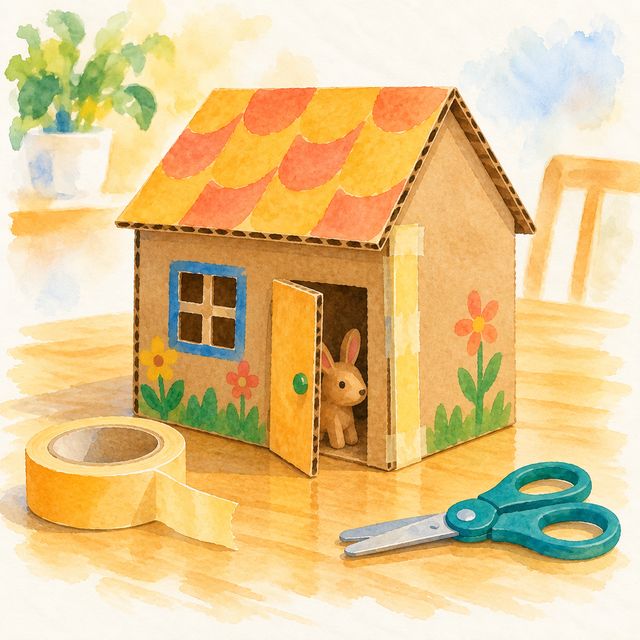
A box house for a real toy, built to pass a test.
Your child builds a house from one box for a toy they own. It has to hold a small book on the roof, have a door that opens and fit the toy through it, and they fix and test it until it does.
- Grade 1–2 to Grade 7–8
- 45 min
- A printout
- On the screen
Free to sign up.
Is it a good fit?
- Ready if Your child can draw round a shape, fold a flap and tape it down.
- Too much today? Start with A cardboard dinosaur: a first make, one step at a time.
- Too easy? The Grade 3–4 level: measure the toy first, cut most of the door with scissors, test with a book on the roof and fix what failed.
What your child practises
- Measuring before cutting
- Testing against a must
- One fix at a time
“I put a strip under the roof, and now the book stays on.”
If your child says something like this, in their own words, the idea has landed. Finishing the rounds means they took part; this is the learning.
Your part
- Gather a cardboard box, tape, a ruler, a pencil, blunt scissors, a small toy, thin card and a small book
- The knife is always yours: at Grade 1–2 your child draws the door and you cut it, and from Grade 3 you cut the window and the door's bottom edge
- More than one sitting: the make comes back at the step it stopped on
What you need
From home
- A medium cardboard box, its bottom taped shut, its top flaps open
- Masking tape or parcel tape
- A ruler
- A pencil
- Blunt scissors
- A craft knife (a grown-up's)
- A small toy that will live in it
- Thin card, such as an empty cereal box, for furniture
- A small book, for the test
The steps
Grade 1–2
 Stand the box up, flaps at the top. Fold the two short flaps down, then the two long flaps over them. Tape along the line where the long flaps meet.
 Stand the box up, flaps at the top. Fold the two short flaps down, then the two long flaps over them. Tape along the line where the long flaps meet.
The other 5 steps, each with its painting, are in the Family portal.
It must pass: It holds a small book on the roof, the door opens, and the toy fits through it.
Grade 3–4
- Stand the box up, flaps at the top. Fold the two short flaps down, then the two long flaps over them. Tape along the line where the long flaps meet.
The other 5 steps, each with its painting, are in the Family portal.
It must pass: The same three tests: the book stays on the roof, the door opens, the toy fits. A test that fails gets one fix, then the test again.
Grade 5–6
- Stand the box up, flaps at the top. Fold the two short flaps down, then the two long flaps over them. Tape along the line where the long flaps meet.
The other 5 steps, each with its painting, are in the Family portal.
It must pass: The three tests pass, and the house was planned on paper in centimetres first.
Grade 7–8
- Stand the box up, flaps at the top. Fold the two short flaps down, then the two long flaps over them. Tape along the line where the long flaps meet.
The other 5 steps, each with its painting, are in the Family portal.
It must pass: The three tests pass, and the plan says the model's scale against your real front door.
Safety
The craft knife is yours at every grade. At Grade 1–2 you cut the door and the window. From Grade 3 you cut the window and the bottom of the door, along the box's bottom edge, and your child cuts the rest of the door with blunt scissors, starting from the end of your cut, because blunt scissors cannot start a cut in the middle of a wall. Your child also uses blunt scissors for the furniture.
Where the facts come from
More like this
The full design
What it is
A house made from one box, for a toy that already exists: it must stand with a small book resting on its flat roof, the door must open, and the toy must fit through it. A project from the first band, because the musts are stated before anything is cut and the house is tested against them at the end.
How it goes
The same shape as the dinosaur: gather, then one step a screen, then Show, then What I learned. The difference is the test step, which is a step like any other and can fail: the book sags the roof, the door sticks, the toy does not fit. The step after it is the fix, one change at a time, and then the test again. What I learned at 3 to 4 asks what you changed to make it work.
The Pet
Asks: "Is the door taller than the toy? Hold the toy up." Notices: "Tested. Whatever happened, you know something now." Reminds whose the knife is, every time, before the cut. Dares when every test passed first time: two books on the roof. It treats a sagging roof as information, never as a mistake.
By band
At every band the box is stood up and its top flaps are folded down and taped flat for the roof: a box's two long flaps meet in the middle, so they make a flat roof, never a ridge. 1 to 2: your child draws the door bigger than the toy and you cut it; they make a bed and a table from thin card. 3 to 4: they measure the toy first and draw the door 3 cm taller and 2 cm wider; you cut the window and the door's bottom edge, they cut the rest of the door with scissors, test with the book and fix what failed. 5 to 6: the house is planned on paper in centimetres before the pencil touches the box, and tested three ways. 7 to 8: they measure a real front door and divide it by the box door, which turns the house into a model to a scale.
What it grows
A stated must turns a craft into engineering, and the must has to be checkable by a child on their own: a book that stays on a roof is checkable, "make it strong" is not. Measuring the thing that has to fit before cutting the hole is the habit the whole strand is for.
Done, and what counts as evidence
Done = the steps done or honestly skipped, and one line chosen. The evidence is what the test did and what the fix was: a strip under the roof, a trimmed door, shorter furniture legs. At 7 to 8 the evidence is the scale, written on the plan.
What's personal
The toy is whichever one your child chose, the furniture is whatever the card allowed, and the advice they would give the next maker is theirs. None of it leaves the family, and the house is never compared to another child's.