History · Pre-K to Grade 1–2
Every year
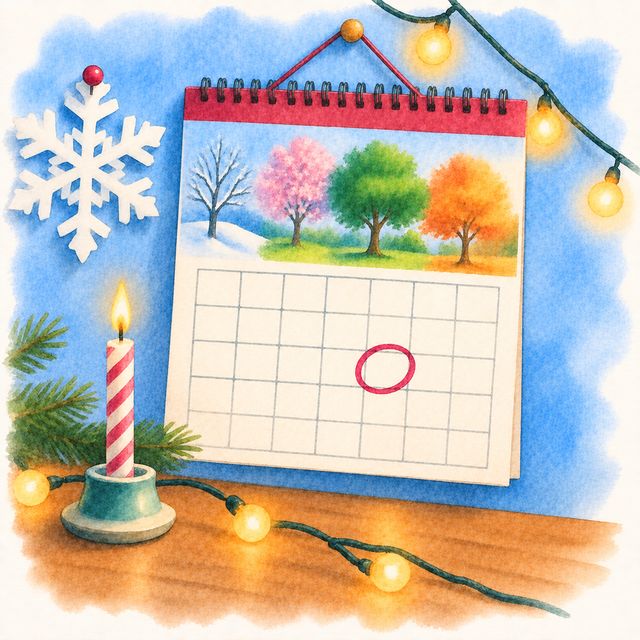
The year as a wheel, with your family's days on it.
The year is a wheel with the months round the edge. Your child places your family's yearly things on it, like birthdays, festivals or the first snow, and watches the wheel turn through the year.
- Pre-K to Grade 1–2
- 10 min
- Nothing to prepare
- On the screen
Free to sign up.
Is it a good fit?
- Ready if Your child knows some days come round again, like a birthday, and can tell a cold time of year from a warm one.
- Too much today? The Pre-K level: one of your family's days placed on the wheel by season, not by month.
- Too easy? The Grade 1–2 level: the other month a moving day can fall in, and your family's tradition told out loud in three steps: first, next, last.
What your child practises
- Seasons
- Months of the year
- Things we do every year
“My birthday comes round every year, in the cold time.”
If your child says something like this, in their own words, the idea has landed. Finishing the rounds means they took part; this is the learning.
Your part
- Add your family's days on the Pet's memory page, under Days you keep every year: a month each, private to your family, and yours to change or erase; no birthdate is ever stored
- Each question has a Read it to me button
- Played with a grown-up
More like this
The full design
What it is
Some things happen every year and come round again: birthdays, the first snow, the festival with the lights, the week at the beach. The year is a wheel, and your family's own things sit on it. This is history's first shape for a small child: "we always", the pattern of a year, and the discovery that another family's wheel has different things in the same season.
How it goes
The wheel fills the screen, the months round the rim, the seasons in four colours. Your child taps a card (a cake, a moon, a string of lights) and then the month it belongs to; a month too early or too late gets a question ("is it a cold time of year, or a warm one?"), never a mark. A festival that moves with the moon is right anywhere near. When the cards are placed the hand spins round the year, naming each thing as it passes. At Pre-K the birthday is the only card; at 1–2 the last card is the friend's.
The Pet
It notices what your child already knows ("Eid moves each year; you remembered that yourself"). It asks about the seasons: cold time or warm time? It remembers last year's answer when there is one, and it reminds, only if you set it, when a family day is two weeks off.
By band
Pre-K: a wheel coloured by the four seasons; one of your family's days placed on it by season, not by month, because a Pre-K child is not hunting twelve month names; then what comes after summer, tapped on the wheel itself; then the year spun once, all the way round. K: up to three of your days placed on their months. 1–2: the same, plus another month a day that moves can fall in, and then your own tradition told out loud to a grown-up in three steps: first, next, last. The seasons follow your half of the world, and the telling is spoken, never typed. The number of cards follows the days a grown-up has entered, and with none entered the wheel still turns on its months and seasons.
What it grows
The year as a cycle is the first sense of time a child builds, and it is built from their own repeated days, not from a calendar. Family traditions, told back by the child, are the earliest form of history: things that were, that will be again, and that are ours.
Done, and what counts as evidence
Done means one wheel filled. At 1–2 the tradition told in three steps is an observation worth keeping, in your child's words.
What's personal
All of it. This game plays with your family's own days: your festivals, your holidays, the week away, in your words. A grown-up adds them on the Pet's memory page for this child, under "Days you keep every year", and can change or erase any of them there. The birthday is one of those days, not a field of its own: MyEdora stores no birthdate for a child anywhere, so a birthday reaches the wheel the same way every other day does, as a month a grown-up entered. Until there are some the wheel still turns, with the months and the seasons and nothing of yours on it, and the finish says where they go. Nothing is assumed about which festivals a family keeps, and the game never suggests one.