History · Grades 3–4 and 5–6
Build it like they did
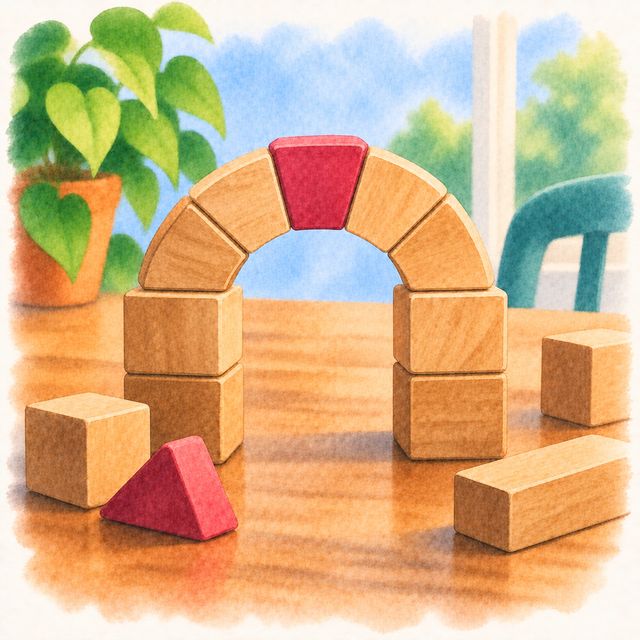
Build what people long ago built, then test it.
Your child builds what people long ago built, like a Stone Age shelter or a Roman arch, from things at home. They test it, find the weak spot, and build it again.
- Grades 3–4 and 5–6
- 45 min
- A kit
- On the screen
Free to sign up.
Is it a good fit?
- Ready if Your child can follow a short brief and build with sticks, a cloth or blocks.
- Too much today? Start with Paper carries a load: a first build and test, with paper.
- Too easy? The Grade 5–6 level: a shaduf or a tub with oars, then two sources about the same tool that do not quite agree.
What your child practises
- How people lived long ago
- Build, test, fix
- Two sources about one tool
“I overlapped the cloth like tiles, so the rain ran off.”
If your child says something like this, in their own words, the idea has landed. Finishing the rounds means they took part; this is the learning.
Your part
- Gather sticks, an old cloth and a watering can, or wooden blocks and a book
- A grown-up for any cutting and for the test itself
- The screen is used before and after: the building happens on the table or in the garden
Take it off the screen (optional)
Take a photo of the build before and after the test, and keep it.
More like this
The full design
What it is
People long ago solved real problems with what they had. Your child builds their answer with the same kind of things, tests it the way the world would have, and when it fails, finds the weak spot and builds again. A Stone Age shelter under a watering can; a Roman arch under a book; an Egyptian shaduf lifting a cup of water; a Greek warship's oars pulled in time. What it teaches is how a society lived, why a design worked, and that the second go is the one that counts.
How it goes
The Pet sets the brief ("no shops, no nails: build me a house that keeps the rain off") and the screen waits while you build, with a grown-up for any cutting and for the test itself. Then the test: your child reports what happened (dry, a bit wet, soaked) and the Pet reports from inside. If it worked, why? If it did not, which bit gave? Your child names the weak spot, rebuilds with one change, and tests again; three goes at most, and every result counts. Then what people needed next (a fire, a door, a bridge), and at 5–6 the two sources.
The Pet
It notices the craft ("you overlapped the cloth like tiles; that is exactly how they did it"). It asks the builder's questions: which block moved first? what if the roof sloped more? It remembers your blanket mountain from Landform builder when you build the shelter. Its dare is one step harder: two books on the arch, two cups on the shaduf.
By band
3–4: a shelter from sticks and a cloth (does it keep the Pet dry?) or an arch from blocks with no glue (does it hold a book?); then why it worked, and what people needed next. 5–6: a shaduf (a weighted pole on a pivot that lifts water) or a tub with lolly-stick oars (does rowing together move it?); then what problem each solved and what it let people do; then two sources that describe the same tool and do not quite agree, and the careful sentence that keeps both.
What it grows
Building and testing is how children of eight and nine come to understand how people lived, better than any picture of a shelter; iteration, the second go after a fail, is the part that stays with them. At ten and eleven, comparing two sources about the same tool is the first careful step into how historians know what they know.
Done, and what counts as evidence
Done means one build tested. The before-and-after photos are a work sample; the "why it worked" and, at 5–6, the sentence that keeps both sources are observations worth keeping.
What's personal
Your own sticks, cloth and blocks, and the society can be your own heritage when you share it ("Grandpa's village had mud-brick houses"). A photo of the build before and after the test is the thing families keep; until the family's photo controls arrive, the screen draws the before and after itself.