Geography · Grades 1–2 and 3–4
Landform builder
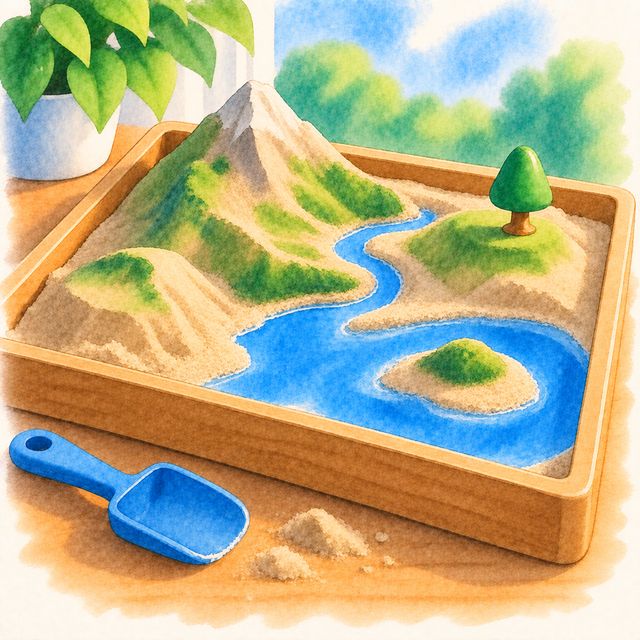
Build mountains and rivers, then see water shape the land.
Your child builds a mountain, a valley or an island out of blankets on the floor, and the Pet walks across it on the screen while your child names each part. Older children pour water on a sand mountain to see a river form.
- Grades 1–2 and 3–4
- 20 min
- Kitchen things
- On the screen
Free to sign up.
Is it a good fit?
- Ready if Your child likes building with blankets and cushions; the words come as they play.
- Too much today? The Grade 1–2 level: blankets and cushions only, and a scarf for the river.
- Too easy? The Grade 3–4 level: one pour of water on sand, and the same words placed on a picture of a real place seen from above.
What your child practises
- Mountain, valley, island and coast
- Where a river runs
- How water shapes the land
“The water went down between the mountains and made a valley.”
If your child says something like this, in their own words, the idea has landed. Finishing the rounds means they took part; this is the learning.
Your part
- Blankets, cushions and a scarf at Grade 1–2; sand and a jug of water, or a towel in the bath, at Grade 3–4
- Alone or with a sibling at Grade 1–2; a grown-up is there for the water at Grade 3–4
- The screen comes before and after the building
Take it off the screen (optional)
Take a photo of the blanket world before it is tidied away.
More like this
The full design
What it is
Mountain, valley, hill, island, river, lake, coast: your child builds them out of blankets on the floor, then names them as the Pet walks the same world on the screen. At 3–4 the water joins in: one jug poured on a sand mountain shows a valley being cut and a delta forming at the "sea". The words come first, then the reason the land looks the way it does: water always finds the low way.
How it goes
The screen asks for the build first ("build me a mountain I can't get over") and waits. Your child taps "it's built" and the Pet sets off across a drawn version of the landscape, stopping on each feature; your child taps its name from the words on the screen. A wrong word gets the feature described again ("water, with land all the way round"), never a mark. Then the river: your child taps where it should run, and the Pet says why the low place is right. Then one question about rain. The dare, once, is a river that splits in two at the sea. At 3–4 the round starts at the sand or the bath, with a grown-up, and the screen asks its one question afterwards.
The Pet
It notices what your child built ("you made the valley between two mountains; that is exactly where they are"). It asks about where water goes ("rain falls on the mountain top; then?"). It remembers this world later, in Where the ice goes and River to the sea.
By band
1–2: build two mountains, a hill, a lake and an island from blankets and cushions; the Pet climbs the same landscape on the screen and asks "what's this?" at each, your child taps the word; then a scarf for a river, put where a river would run. 3–4: one pour of water on a sand or bath landscape and one question about it (which way did the water go? what did it do at the bottom?); then the same six words placed on a picture of a real place seen from above, and the last question: which way would the water go here?
What it grows
Children of six and seven learn landform words fastest when they have made the shapes with their hands, and the idea that water shapes land (a valley is cut, a delta is dropped) is one of the first cause-and-effect stories of Earth science at eight and nine. A single pour, watched closely, teaches it better than a page of pictures.
Done, and what counts as evidence
Done means one landscape built and walked. A photo of the blanket world is a work sample; at 3–4 the picture with its six labels, and one line in your child's words about where the water went, are observations worth keeping.
What's personal
The picture from above at 3–4 is a painted place until you share a photo of your own nearest hill, river or coast; then it is yours. A photo of the blanket world is the thing children want to keep, and it stays in your family.