History · Grade 1–2 to Grade 5–6
Before the headline
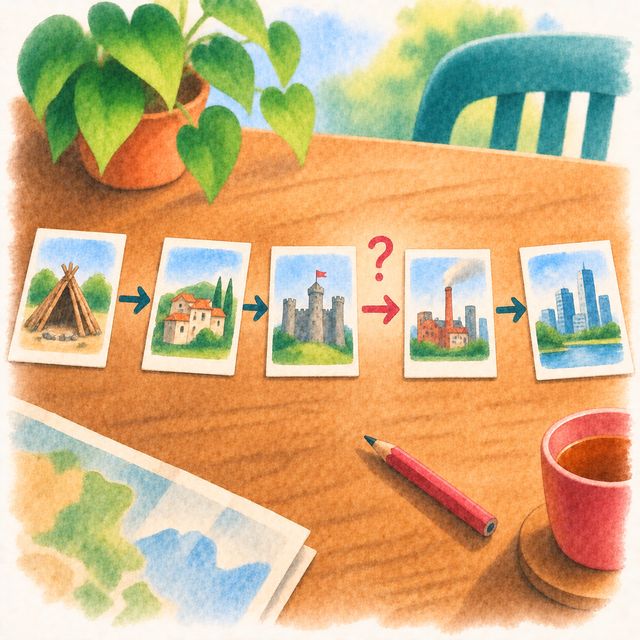
Coming first is not the same as causing, checked card by card.
Your child lays out one event and cards for what came before it, and draws a because arrow only where a card says how it helped. On the screen they check each arrow and keep the ones that hold up.
- Grade 1–2 to Grade 5–6
- 20 min
- A printout
- On the screen
Free to sign up.
Is it a good fit?
- Ready if Your child can listen to a short card and say what it tells.
- Too much today? Start with Then and now: what changed and why, before what caused what.
- Too easy? The Grade 5–6 level: two sources that tell how a great fire began differently, and one arrow marked "we are not sure", with a reason from a card.
What your child practises
- Cause and consequence
- The spark and the dry wood
- Checking a claim against a source
“That only came first. It didn't make it happen.”
If your child says something like this, in their own words, the idea has landed. Finishing the rounds means they took part; this is the learning.
Your part
- Paper and a pencil to copy the cards
- Each question has a Read it to me button
- At Grade 1–2 a grown-up reads the cards and hears how one arrow helped; from Grade 3–4 your child plays alone
Take it off the screen (optional)
Ask together why your family lives where it does, and which reasons only came first.
More like this
The full design
What it is
Something happening earlier does not mean it caused what came next. Your child lays one event on the table, puts the things that came before it around it, and draws an arrow only where they can say how that thing helped bring the event about. Some arrows survive, some do not, and one may have to be marked "we are not sure". That is how a historian thinks, and it starts with a bridge, or the first airplane.
How it goes
Copy the event and its cards onto paper, lay the cards round the event, and draw a "because" arrow wherever your child thinks one belongs. Then lay the same web out on the screen: your child taps each card and says whether it tells how it helped, or only that it came first. Kept arrows stay, the rest are taken away (a wrong call is answered with a look at the card, never marked), and the Pet walks the arrows that held up into the event. From about eight the Pet brings a card of its own; from about ten two cards tell the beginning differently, and one arrow is marked "we are not sure", with a reason from a card.
The Pet
It notices: "every arrow left has a card behind it." It asks: "does it say how it helped?" It brings its own card, the comets people once said warned of trouble, and draws an arrow your child should take away. It remembers: "last time one card only came first." Its dare, from about eight: "bet you can mark an arrow not sure, and say why", played at once; from about ten, a question to take to a grown-up tonight: why do we live where we do?
By band
1–2: an event a child understands, the Golden Gate Bridge opening or the first airplane flight, and two things that helped it happen, talked through with you. 3–4: the spark and the dry wood: which thing set the event off, and which had been building for a long time; and one card that only came before and did nothing. 5–6: two sources that explain the same event differently, and one arrow the child marks uncertain, with a reason.
What it grows
Cause and consequence is one of the few ideas that make history a way of thinking rather than a list of dates, and children can begin it early when the event is small and the evidence is on the table. No arrow stands on "it came first", and the game never pretends to know what would have happened otherwise.
Done, and what counts as evidence
Done means a web where every arrow that is left has something behind it. The web, its reasons and its one "not sure" make a work sample. This is not a sequence game like My day in order or Timeline of everything: the order is given; the question is what caused what.
What's personal
The game brings real events at every age, in cards we wrote from the record of each. Your family's own event (why did we move house, why did we get the dog), with your own cards, is a later addition, not built yet; ask it at the table meanwhile. The web your child builds stays in your family's account.