Geography · Kindergarten to Grade 5–6
Who can get there?
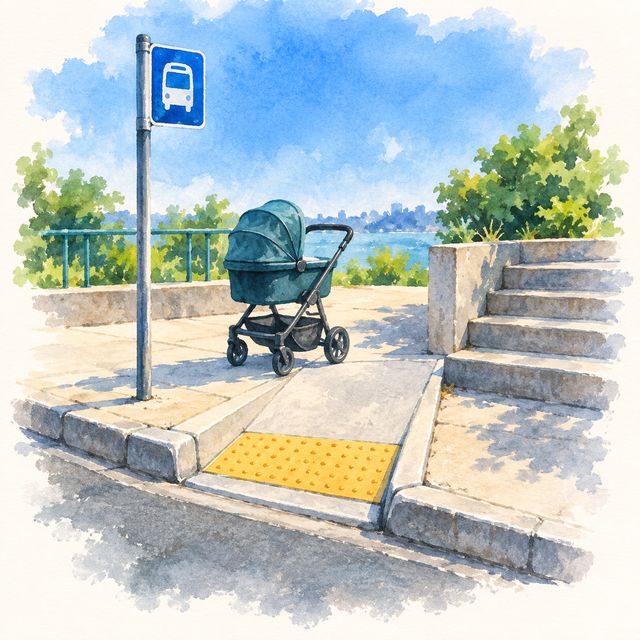
See a familiar walk through someone else's eyes.
Your child walks a familiar route with someone who finds it hard, and asks what makes it difficult. Back home they mark each step, slope or bench on a strip, and the Pet walks it as that person would.
- Kindergarten to Grade 5–6
- 20 min
- Nothing to prepare
- On the screen
Free to sign up.
Is it a good fit?
- Ready if Your child can spot a step or a ramp and tell you whether it helps.
- Too much today? The Kindergarten level: one thing seen on the walk, and whether it helps or blocks.
- Too easy? The Grade 5–6 level: four things the town could do, put in order with the person's own need first.
What your child practises
- What helps and what blocks
- Asking before deciding
- Shortest or easiest
- Drawing a route
“The short way has a step, so the long way is easier for Grandma.”
If your child says something like this, in their own words, the idea has landed. Finishing the rounds means they took part; this is the learning.
Your part
- Nothing to prepare
- Walk a route you know with the person whose walk it is, such as a grandparent with a stick or a grown-up with a pushchair
- The route is a drawing, never tracked: no address and no photos of people
Take it off the screen (optional)
Walk to the same shop thinking of someone else: a pushchair, a toddler, a bike.
More like this
The full design
What it is
A place can be close and still hard for a particular person to reach. Your child walks a route they know with someone for whom it is not easy, asks that person what makes it hard, and looks at the ground, the crossings, the doors and the places to sit through their eyes. Back at the screen they draw the walk as a strip and watch the Pet walk it as that person would, stopping where they stop. The lesson is that near is not the same as reachable, and that the person's own words come before anyone's idea of what would help.
How it goes
The screen asks first: ask your partner what makes their walk difficult, agree one thing to watch for, and walk it together (no photos of people). Then your child reports what the partner said, picks things from a list (a step, a handrail, a high kerb, a dropped kerb, crossing lights, a bench, loose gravel, a slope, a heavy door, a tree) and taps where each was on the strip. Then the Pet walks the strip as the partner: it stops at every blocker and says why. A judgement the Pet would not have made ("a slope helps her") gets one question and is then kept as your child's, because they were there and the Pet was not. At 3–4 a second strip for the other route; at 5–6 the four improvements in order.
The Pet
It notices the asking ("you asked her first, before deciding; that is the first step"). It asks whether the shortest route is the easiest one for this journey. It remembers the difficult kerb next time. Its dare at 5–6 is the same shop for a different person: a pushchair, a toddler, a bike.
By band
K: one thing seen on the walk that helps the partner or blocks them (a step, a ramp), on the path, and a choice: helps or blocks. 1–2: a few things on the strip in order, home to shop, then the Pet walks it and stops at each blocker. 3–4: two routes, the shortest and the longer way round, both drawn, and the question of which the partner said is easier, because shortest and easiest are different questions. 5–6: four things the town could do, put in order with the partner's own stated need first, and the strip as the evidence.
What it grows
Fieldwork on a familiar route is the first geography children do, and asking a real person about their journey turns "how do we get there?" into "who can get there?", the question behind every accessible street. Children from five can notice one feature; from eight they can compare routes and argue from what someone told them.
Done, and what counts as evidence
Done means one walk and one strip. The strip with one proposed improvement is a work sample; at 5–6 the order of improvements, with the partner's words as the reason, is an observation worth keeping.
What's personal
The partner by the name your child uses, and their need in their own words, willingly shared; the route is a drawing, never a trace, with no address and no faces. Nothing is diagnosed, and nobody is asked to pretend to have a difficulty: your child listens instead.