Geography · Kindergarten to Grade 3–4
Treasure walk
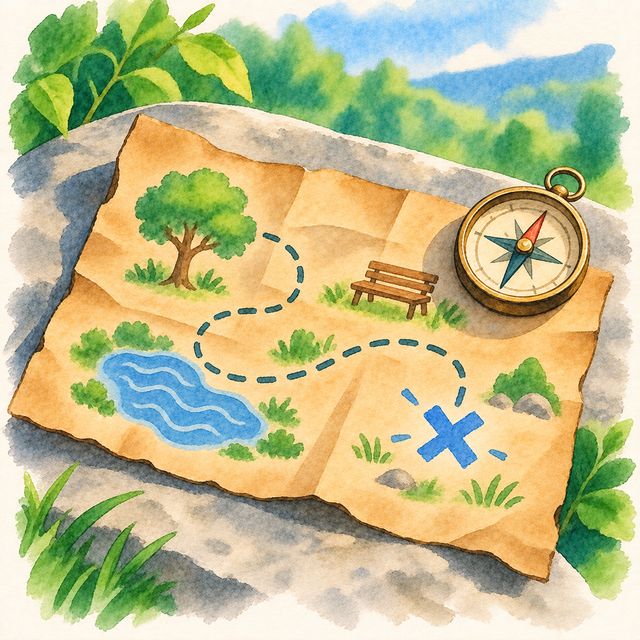
Read a map on a real walk and find the treasure.
You hide a small treasure on a walk you know, by three landmarks like a door, a tree and a postbox. Your child leads with the map on the screen and ticks off each landmark as they reach the real one.
- Kindergarten to Grade 3–4
- 20 min
- Kitchen things
- On the screen
Free to sign up.
Is it a good fit?
- Ready if Your child can point out a door, a tree and a postbox on a walk you both know.
- Too much today? Start with My map: the words for where things are, in one painted room, before a real walk.
- Too easy? The Grade 3–4 level: a compass rose, which way each leg went, and your child's own steps turned into metres.
What your child practises
- Landmarks on a map
- Holding a route in order
- Compass directions
- Steps into metres
“North to the tree, then east to the postbox.”
If your child says something like this, in their own words, the idea has landed. Finishing the rounds means they took part; this is the learning.
Your part
- Pick a door, a tree and a postbox on a walk you know, and hide a small treasure by the last one
- A grown-up leads the walk and goes all the way; the game never knows or records where you went
- Each question has a Read it to me button
Take it off the screen (optional)
From Grade 1–2, draw the way home on paper from memory, the landmarks in the order you passed them.
More like this
The full design
What it is
A real walk with a picture map. The map on the screen shows three landmarks on a lane: a red door, a big tree, a postbox. Before you go, you pick a real door, a real tree and a real postbox (or a pole, a sign, a gate) on a walk you know, and hide a small treasure by the last one. Then your child leads, holding the map, and taps each landmark on the screen when they reach the real one. Reading a map by its landmarks is the first map skill there is, and this one is walked, not looked at.
How it goes
The Pet says your grown-up hid something, and the screen shows the map and the three stops in order. Out you go. At the real door your child taps the red door on the map and it gets a tick; the same at the tree; at the postbox the treasure's X appears and the Pet cheers. A tap on the wrong thing is answered, never marked: "not yet, stop 1 first: the red door", or "the bench is not a stop". At 1–2 the walk home draws a dotted line on the map, one landmark at a time. At 3–4 the compass round asks each leg's direction from four chips, and the steps round has a counter that moves in fives (a child who counted 63 sets it to about 65 in five taps) and then three metre amounts to choose from.
The Pet
Asks: "first: the red door. Tap it when you are there." Notices each stop: "Big tree. One more." At 3–4: "North, then east. You read the rose, not the road." Dares (3–4): pace the next leg too, from the tree to the postbox. The Pet never says where the sun or the cold is: that depends on where in the world you live.
By band
K: follow the map, three stops, to the treasure. 1–2: after the treasure, walk home and draw the way back on the map by tapping the landmarks in the order you pass them: postbox, tree, door. 3–4: the map has a compass rose; your child says which way each leg went (north to the tree, then east to the postbox), then counts their own steps from the door to the tree and turns the count into metres, at about half a metre a step.
What it grows
Map skills grow in this order between four and eight: landmarks first, then a compass rose, then scale. A route walked and then drawn back is how the first of those becomes the second: the child has to hold the order of the places in their head and turn it round.
Done, and what counts as evidence
Done = one walk to the treasure. What counts as evidence is the walk itself and, at 1–2, the way back drawn in the right order; on paper from memory it is a work sample. The grown-up who led the walk records it.
What's personal
The walk is yours: which door, which tree, which post, and what the treasure is. Nothing on the screen is a place: the map is a picture the Pet drew, the same for every family, and the game never knows or records where you walked. The step count is your child's own, and so is the drawn way back.