Geography · Grades 3–4 and 5–6
River to the sea
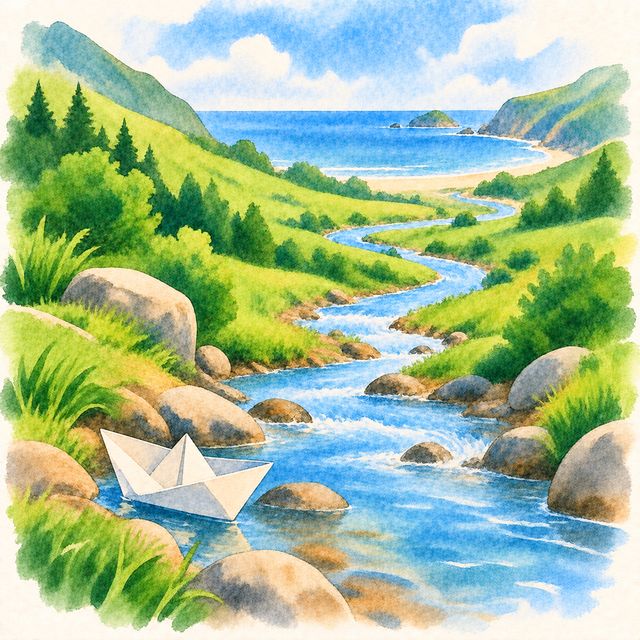
Follow a leaf downhill, all the way to the sea.
Your child drops a leaf into the nearest stream and watches where it goes. Back home they trace its way downhill to the sea on a map.
- Grades 3–4 and 5–6
- 30 min
- A printout
- On the screen
Free to sign up.
Is it a good fit?
- Ready if Your child can make a guess and then watch to see if it was right.
- Too much today? Start with Rivers of the world: rivers on a world map, source and sea, without the walk.
- Too easy? The Grade 5–6 level: contour lines, the high ground that drains into your stream, and what a week of rain would do.
What your child practises
- Source, mouth and bank
- Water runs downhill
- Contour lines
- Where tap water comes from
“It went downhill, like I guessed.”
If your child says something like this, in their own words, the idea has landed. Finishing the rounds means they took part; this is the learning.
Your part
- A leaf or a paper boat; or a tray, kitchen foil and a jug of water at the table
- A grown-up goes along to the water
- The screen comes before and after, and nothing about the walk is recorded
Take it off the screen (optional)
Find out together where your tap water starts, by asking a grown-up or the water company.
More like this
The full design
What it is
Where does the water go? Your child drops a leaf in the nearest running water, watches which way it goes, and then follows it on a map, downhill all the way to the sea. At 5–6 the map gains contour lines and the question turns to why: which ground drains into our stream, where our tap water starts, where the drain ends, and what a week of rain would do.
How it goes
The screen sends you out first ("I dropped my hat in the stream; where will it end up?") and waits. Back home, your child says what they guessed and what the leaf did, then taps the way to the sea one part at a time; a leaf on the map floats along behind the taps. A tap on the branch that peters out in the marsh gets the Pet's question, not a mark: which branch is wider, and which way is the sea? Then three words to place on the map. At 5–6 the same map, with the rings, and the four questions above, each with a few answers to choose from. If you have no stream nearby, the round starts at the table: a foil landscape in a tray, one person pouring at the top, one watching where it arrives.
The Pet
It notices the guess ("you said downhill before you dropped it, and it did"). It asks at the fork: which branch is bigger, which way is the sea? It remembers the valley poured in Landform builder ("this is the real one"). Its dare at 5–6 is to find out where your tap water starts, which means asking a grown-up or the water company.
By band
3–4: guess which way the leaf will go before it goes; drop it; then trace the stream on the map from its start, through the place where another stream joins, along the river, past the fork, to the mouth, and name the three parts (source, mouth, bank). 5–6: read the contour rings and pick the route water would take from the spring; tap the four high points that rim our stream's catchment; say where your tap water comes from and where the drain goes; predict what a week of rain does to the river and the flat land beside it.
What it grows
Following water from source to mouth is how rivers are first taught at eight and nine, and a real leaf in a real stream fixes the idea that water only ever goes down. Contour lines and catchments at ten and eleven are the step from "where" to "why", and joining the tap and the drain into the same cycle is what makes the water in the house part of the river outside.
Done, and what counts as evidence
Done means one trace to the sea. At 5–6 the drawn catchment is a work sample and the week-of-rain prediction is a line worth keeping in your child's words.
What's personal
The stream is called by your family's name for it. The map is a drawing, not a location: nothing about the walk is recorded, and no route is traced. Where your tap water comes from is your own answer (a reservoir in the hills, a river, a well, or the sea through a desalination plant, depending on where you live), and the game must take it.