Math · Kindergarten to Grade 1–2
Paper weaving
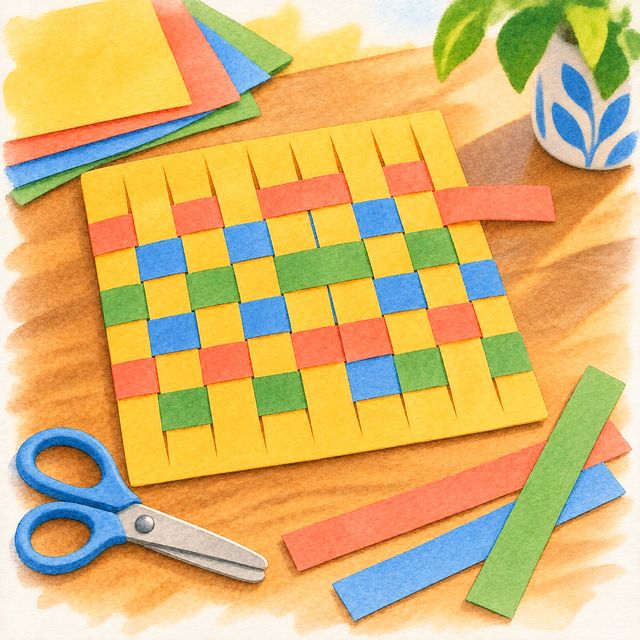
A woven paper mat with a pattern your child chose and kept going.
Your child weaves strips of coloured paper over and under through slits in another sheet, so the colours make a checked pattern. At 1–2 they cut the slits and plan the pattern first.
- Kindergarten to Grade 1–2
- 15 min
- A printout
- On the screen
Free to sign up.
Is it a good fit?
- Ready if Your child can push a strip of paper through a slit and pull it out the other side.
- Too much today? The K level: you cut, your child weaves.
- Too easy? The 1–2 level: ruled, cut and patterned by your child.
What your child practises
- Over and under
- Repeating a pattern
- Cutting on a line
“This one starts under, so it makes squares.”
If your child says something like this, in their own words, the idea has landed. Finishing the rounds means they took part; this is the learning.
Your part
- Find three or four sheets of coloured paper
- Cut the slits and strips at K
- Fifteen minutes, at the table
What you need
From home
- A sheet of coloured paper for the mat
- Two or three more sheets in other colours, for the strips
- Blunt scissors
- A ruler and a pencil
- A glue stick
The steps
Kindergarten
 Fold the mat sheet short edge to short edge. From the fold, rule lines two fingers apart, end ones a finger in. Stop each a finger before the far edge. (A grown-up does this step)
 Fold the mat sheet short edge to short edge. From the fold, rule lines two fingers apart, end ones a finger in. Stop each a finger before the far edge. (A grown-up does this step)
The other 5 steps, each with its painting, are in the Family portal.
It must pass: Over and under, the whole way across.
Grade 1–2
- Fold the mat sheet short edge to short edge. From the fold, rule lines two fingers apart, end ones a finger in. Stop each a finger before the far edge.
The other 5 steps, each with its painting, are in the Family portal.
It must pass: The pattern repeats all the way across the mat.
Safety
At K you cut the slits and the strips; from 1–2 your child uses blunt scissors, beside you. Nothing here is small enough to swallow.
Where the facts come from
More like this
The full design
What it is
A sheet of coloured paper with slits cut across it, and strips of other colours woven through, over and under, so the colours make a checked pattern that repeats. The screen gathers the things, shows one step at a time as a painting of that step, and asks at the end. The mat on the table is the make.
How it goes
One step fills the screen: the painted plate of that step, the words under it, and two buttons. Done this step moves on. Too hard, skip it also moves on, and the finish says how many were skipped without dressing it up. At the end, Show asks what is true (it makes squares, it has a pattern that repeats), and What I learned asks the band's question.
The Pet
Asks at each step: "This one starts under. Push it close." Notices: "Look: it makes squares." Remembers across a pause, so a half-woven mat comes back where it stopped. A torn strip is just another strip to take.
By band
K: you fold the mat sheet, rule and cut the slits, and cut the strips; your child weaves each strip over and under, across the slits, and folds and glues the ends behind. 1 to 2: your child folds the sheet and rules the lines on it, cuts the slits and the strips, and chooses a pattern of two or three colours before starting, so it repeats all the way across.
What it grows
Early learning frameworks name noticing and making repeating patterns as early maths, and cutting along a line as a fine motor skill that grows from 4 to 5. Weaving uses both at once, and the pattern either repeats or it does not, which a child can check alone.
Done, and what counts as evidence
Done = the steps done or honestly skipped, and one line chosen at the end. The evidence is the mat, and at 1 to 2 whether the pattern your child chose repeats to the end, and what they say makes it repeat: each strip starting the other way.
What's personal
Your child's colours and answers are stored as their answer, not as a mark. Nothing about your home is stored. A material you do not have is named once, a substitute is offered, and the make carries on.