Science · Pre-K to Grade 1–2
Fruit faces
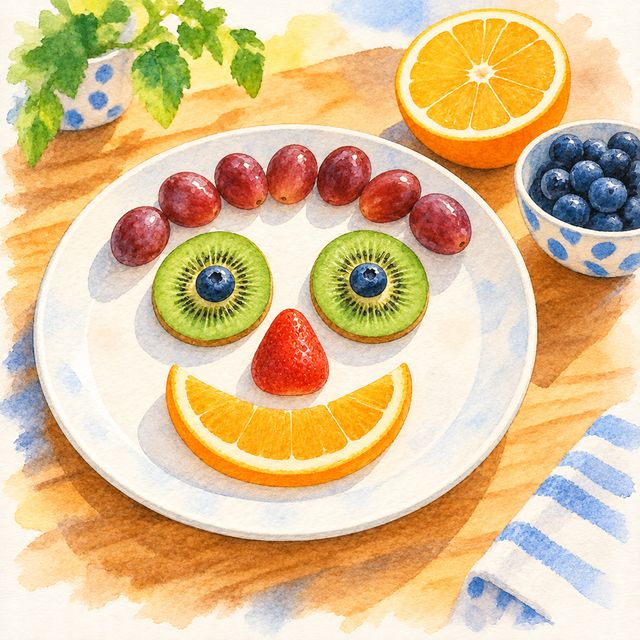
A smiling face your child made from fruit, and then ate.
Your child washes and peels fruit, you cut it, and they lay it out on a plate as a face with eyes, a nose, a smile and hair. At 1–2 they plan it on paper first.
- Pre-K to Grade 1–2
- 15 min
- A printout
- On the screen
Free to sign up.
Is it a good fit?
- Ready if Your child can wash their hands and peel a banana with a little help.
- Too much today? The Pre-K level: wash, peel, a face, and eat it.
- Too easy? The 1–2 level: planned on paper, then counted by kind.
What your child practises
- Washing and peeling
- Making a pattern
- Planning, then making
“The grapes are the hair, in a pattern.”
If your child says something like this, in their own words, the idea has landed. Finishing the rounds means they took part; this is the learning.
Your part
- Put out three or four kinds of fruit
- Cut it: grapes in quarters lengthways, blueberries in half
- Stay at the table while they eat
What you need
From home
- A big plate
- Fruit from the bowl: a banana, a mandarin, an apple, grapes, strawberries and blueberries (small parts)
- A knife and a chopping board (a grown-up's)
- A colander, or a bowl of water for washing
- Paper and coloured pencils, for the plan at 1–2
The steps
Pre-K
 Wash your hands. Then wash the fruit in the colander and shake it dry.
 Wash your hands. Then wash the fruit in the colander and shake it dry.
The other 4 steps, each with its painting, are in the Family portal.
Kindergarten
- Wash your hands. Then wash the fruit in the colander and shake it dry.
The other 5 steps, each with its painting, are in the Family portal.
Grade 1–2
- Draw your face on paper first. Which fruit for the eyes, the nose, the mouth and the hair?
 Draw your face on paper first. Which fruit for the eyes, the nose, the mouth and the hair?
The other 5 steps, each with its painting, are in the Family portal.
It must pass: It is made from your plan, and you can say what you changed and why.
Safety
The knife is yours at every grade. At every grade here, cut grapes into quarters lengthways, halve blueberries and other small round fruit, and slice apple thin, because whole grapes and round pieces are a choking risk for young children; and have them eat sitting down, with you at the table. Wash hands and fruit first. Leave out any fruit someone at home is allergic to.
Where the facts come from
More like this
The full design
What it is
Fruit from the bowl, washed and peeled by your child and cut by you, laid out on a big plate as a face: eyes, a nose, a smile, and hair along the top. Then shown to someone and eaten. The screen gathers the things, shows one step at a time as a painting of that step, and asks at the end. The plate on the table is the make.
How it goes
One step fills the screen: the painted plate of that step, the words under it, and two buttons. Done this step moves on. Too hard, skip it also moves on, and the finish says how many were skipped without dressing it up. At the end, Show asks what is true (it is smiling, I chose every piece), and What I learned asks the band's question.
The Pet
Asks at each step: "Two eyes first. Then a nose. Then a smile." Notices: "A face. It is smiling at you." Remembers: the cut fruit can wait in the fridge and the make comes back where it stopped. It says nothing about which foods are good or bad: the make is about the hands.
By band
Pre-K: your child washes and peels; you cut; they make a face and eat it. K: the same, and the hair is a repeating pattern, grape, blueberry, grape, blueberry. 1 to 2: your child plans the face on paper first, makes it from the plan, and counts how many pieces of each fruit they used.
What it grows
Children from 3 to 5 can wash, tear and mash in the kitchen, and blunt cutting comes later, which is why the knife stays yours. A review of 21 cooking studies with children aged 4 to 12 found gains in cooking confidence and a smaller one in eating vegetables; none measured maths or reading, so this page claims neither.
Done, and what counts as evidence
Done = the steps done or honestly skipped, and one line chosen at the end. The evidence is the face on the plate, the pattern at K kept going without help, and at 1 to 2 the plan beside the plate and the count of each kind.
What's personal
Which fruit your child liked best and what they changed are stored as their answer, not as a mark. Nothing about your home, your food or anyone's diet is stored. A fruit you do not have is named once, a substitute is offered, and the make carries on.