Math · Grade 3–4 to Grade 7–8
A cardboard arcade game
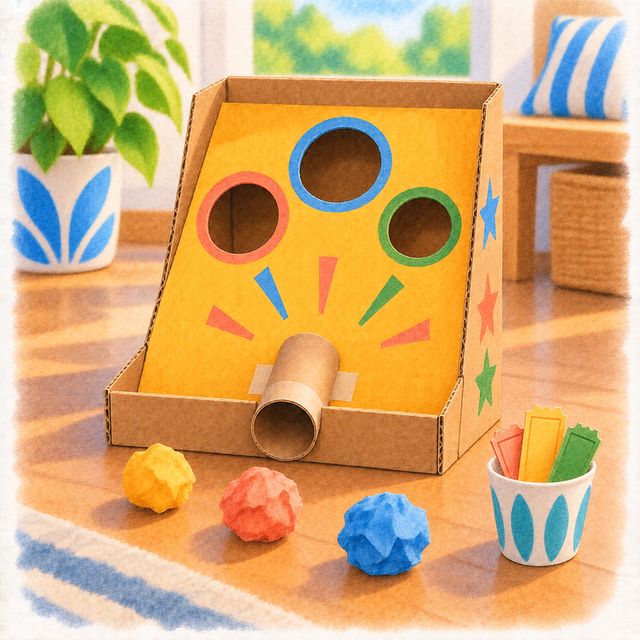
An arcade game your child built from a box, that the family played.
You cut a big side off a box and three holes your child draws in it; your child leans it on the wall as a ramp, scores the holes, and the family rolls paper balls into them. At 7–8 they tally five players to check the points are fair.
- Grade 3–4 to Grade 7–8
- 90 min
- A printout
- On the screen
Free to sign up.
Is it a good fit?
- Ready if Your child can add three small numbers.
- Too much today? The 3–4 level: a rule, three holes, one game played.
- Too easy? The 7–8 level: a tally of five players.
What your child practises
- Making a rule
- Adding scores
- Testing and improving
“Nobody got the small one, so I made it worth more.”
If your child says something like this, in their own words, the idea has landed. Finishing the rounds means they took part; this is the learning.
Your part
- Save a large box
- Cut the ramp, the holes and the gutter with the craft knife
- Play it
What you need
From home
- A large cardboard box, with a side at least 50 cm by 35 cm
- A craft knife and a cutting board (a grown-up's)
- Tape
- Scrap paper, for balls and for scores
- Felt pens or paint
The steps
Grade 3–4
 A grown-up cuts off a big side. Along one short edge, draw round things 7, 9 and 12 cm across, each 3 cm clear of it. A grown-up cuts them. (A grown-up does this step)
 A grown-up cuts off a big side. Along one short edge, draw round things 7, 9 and 12 cm across, each 3 cm clear of it. A grown-up cuts them. (A grown-up does this step)
The other 4 steps, each with its painting, are in the Family portal.
It must pass: It has a rule and a way to win, and someone in the family plays it.
Grade 5–6
- A grown-up cuts off a big side. Along one short edge, draw round things 7, 9 and 12 cm across, each 3 cm clear of it. A grown-up cuts them. (A grown-up does this step)
The other 5 steps, each with its painting, are in the Family portal.
It must pass: It has a rule and a way to win, the family plays it, and you changed one thing after watching them.
Grade 7–8
- A grown-up cuts off a big side. Along one short edge, draw round things 7, 9 and 12 cm across, each 3 cm clear of it. A grown-up cuts them. (A grown-up does this step)
The other 5 steps, each with its painting, are in the Family portal.
It must pass: Five players' balls are tallied, misses too, and the points checked against the tally, changed if the hole hit least was not worth most.
Safety
The craft knife is yours at every grade here: open the box out flat first, then cut the ramp off it, the holes your child draws, and the gutter strip, each with the cardboard lying flat on a cutting board, and the knife goes away after. Tape the ramp's bottom edge to the floor so it cannot slide. Paper balls only, nothing hard.
Where the facts come from
More like this
The full design
What it is
A big flat side cut from a cardboard box, three holes of different sizes cut in a row near one end, and the side leaned against a wall as a ramp, each hole ringed in a colour and worth more the smaller it is. Paper balls are rolled up it from a line on the floor, and a ball that goes in lands under the ramp. It has a rule and a way to win, and it is finished when the family plays it. The screen shows one step at a time as a painting of that step and asks at the end.
How it goes
One step fills the screen: the painted plate of that step, the words under it, and two buttons. Done this step moves on. Too hard, skip it also moves on, and the finish says how many were skipped without dressing it up. At the end, Show asks what is true (someone played it, people wanted another go), and What I learned asks the band's question.
The Pet
Asks at each step: "Watch them play. Then change one thing." Notices: "Tested and changed. Play again to see." Remembers across the three sittings. It never keeps a score of its own: the scores are the family's.
By band
3 to 4: the ramp, the holes you cut, the points and the rule, a game played by someone in the family. 5 to 6: a gutter under the holes so the balls roll back out, and one change made after watching the family play. 7 to 8: five players' balls tallied hole by hole, misses too, and the points checked against the tally, changed if the hole hit least is not worth most.
What it grows
The engineering standards ask children to improve a design by testing it, and in middle school to evaluate it against data. A game is tested by its players, and its fairness is a question a tally of five players can answer.
Done, and what counts as evidence
Done = the steps done or honestly skipped, and one line chosen at the end. The evidence is a game other people played, and from 5 to 6 the change made after watching them; at 7 to 8, a tally that tests whether the points are fair.
What's personal
Players' names and scores stay on your paper; only your child's answers are stored, as their answer, not as a mark. A material you do not have is named once, a substitute is offered, and the project carries on.