Science · Grade 3–4 to Grade 7–8
Bread in a bag
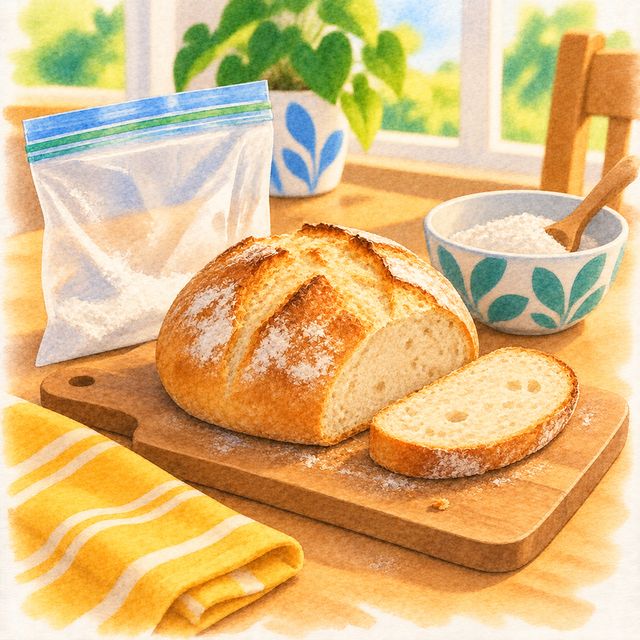
A small loaf your child measured, mixed and watched rise.
Your child measures flour, yeast, sugar, salt and warm water into a zip-top bag, squishes it into dough, lets it rise for an hour and bakes it with you. At 7–8 they test warm water against cold.
- Grade 3–4 to Grade 7–8
- 60 min
- A kit
- On the screen
Free to sign up.
Is it a good fit?
- Ready if Your child can read a scale or a measuring jug with a little help.
- Too much today? The 3–4 level: measured and squished in the bag; you bake it.
- Too easy? The 7–8 level: two doughs, warm and cold, compared.
What your child practises
- Measuring
- Watching a change
- A fair test
“The yeast is alive, and it made the dough grow.”
If your child says something like this, in their own words, the idea has landed. Finishing the rounds means they took part; this is the learning.
Your part
- Buy a packet of fast-action dried yeast
- Do the oven at 3–4 and 5–6, and stand beside it at 7–8
- Allow an hour for the rise between the two sittings
What you need
From home
- Flour (bread or plain), sugar and salt: 150 g of flour for each dough, and a little more for the table and the tray
- Warm water and a measuring jug
- A large zip-top bag, or two at 7–8
- Kitchen things: scales, a teaspoon, a clear bowl (two the same at 7–8), a tea towel, masking tape, a pen and a ruler
- A baking tray, oven gloves, a wire rack and the oven (a grown-up's)
From a local store
- Fast-action (instant) dried yeast
The steps
Grade 3–4
 Stand the bag in a bowl on the scales and zero them. Add 150 g of flour, a teaspoon of sugar and half a teaspoon each of yeast and salt.
 Stand the bag in a bowl on the scales and zero them. Add 150 g of flour, a teaspoon of sugar and half a teaspoon each of yeast and salt.
The other 4 steps, each with its painting, are in the Family portal.
It must pass: It rises, and you measured the flour and the water yourself.
Grade 5–6
- Stand the bag in a bowl on the scales and zero them. Add 150 g of flour, a teaspoon of sugar and half a teaspoon each of yeast and salt.
The other 5 steps, each with its painting, are in the Family portal.
It must pass: It rises, and you measured how much it grew.
Grade 7–8
- A fair test: two doughs the same in every way but the water. Stick tape on two bags. Draw a sun on one, a snowflake on the other.
 A fair test: two doughs the same in every way but the water. Stick tape on two bags. Draw a sun on one, a snowflake on the other.
The other 5 steps, each with its painting, are in the Family portal.
It must pass: You tested warm water against cold, and can say which rose more and why.
Safety
The oven is yours at 3–4 and 5–6: you put the tray in and take it out. At 7–8 your child may do it with oven gloves, beside you. The water is warm, never hot. Raw dough is not eaten or tasted, and everyone washes their hands with soap after handling flour or dough.
Where the facts come from
More like this
The full design
What it is
Flour, yeast, sugar, salt and warm water measured into a zip-top bag, squished into a dough, left somewhere warm to rise for an hour, shaped and baked into a small round loaf. Measuring comes first and the rise is something your child can see, and from 5 to 6, measure. The screen gathers the things, shows one step at a time as a painting of that step, and asks at the end. The loaf is the make.
How it goes
One step fills the screen: the painted plate of that step, the words under it, and two buttons. Done this step moves on. Too hard, skip it also moves on, and the finish says how many were skipped without dressing it up. The hour's rise is a pause the make expects. At the end, Show asks what is true (it rose, it has holes inside), and What I learned asks the band's question.
The Pet
Asks at each step: "Warm, not hot. Squeeze the air out. Seal it." Notices: "It rose. The yeast did that." Remembers across the hour: the paused card says to keep the dough warm. It says raw dough is for baking, not tasting, and it says nothing about what anyone should eat.
By band
3 to 4: your child measures everything and squishes the bag; the oven is yours. 5 to 6: the dough is kneaded on the table, its height marked, and the rise measured after an hour. 7 to 8: a fair test, two small doughs made with warm and with cold water, compared after an hour, and your child may use the oven with gloves, beside you.
What it grows
Children from 7 can measure and use a peeler and a thermometer in the kitchen, and from 9 can use the stove with oversight, which is where the oven steps sit. A review of cooking studies with children found gains in cooking confidence; none measured maths, so this page claims the measuring is practised, not that it is taught.
Done, and what counts as evidence
Done = the steps done or honestly skipped, and one line chosen at the end. The evidence is the loaf, the measuring your child did, and from 5 to 6 the measured rise; at 7 to 8 a fair test with its result and its reason.
What's personal
Your child's measurements and answers are stored as their answer, not as a mark. Nothing about your home or your food is stored. A material you do not have is named once, a substitute is offered, and the project carries on.