Science · Grades 5–6 and 7–8
Where does it go?
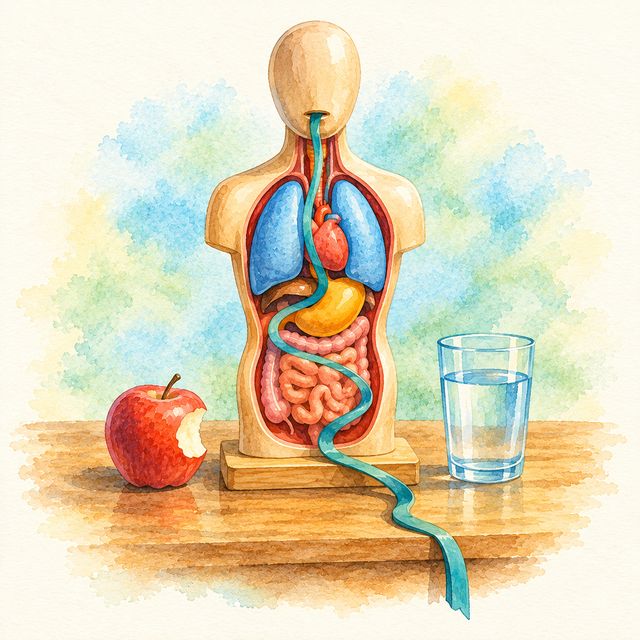
Your child follows air, food and blood through the body and sees how the parts work together.
Your child follows air, food and blood through a drawn body and checks four things the Pet believes, by sorting the parts' jobs, choosing an answer, or tapping the parts in order while the drawing traces the path. At Grade 7–8 the Pet goes for a run and your child says what changes and why.
- Grades 5–6 and 7–8
- 15 min
- Nothing to prepare
- On the screen
Free to sign up.
Is it a good fit?
- Ready if Your child knows the heart beats and the lungs breathe.
- Too much today? Start with Who lives here?: a living system, a food chain, before the body as one.
- Too easy? The Grade 7–8 level: what changes when the Pet goes for a run, why the breath speeds up, and the oxygen's way to a leg muscle.
What your child practises
- What the main organs do
- The path of food and of air
- The heart as a pump
- How body systems work together (Grade 7–8)
“The blood carries it there.”
If your child says something like this, in their own words, the idea has landed. Finishing the rounds means they took part; this is the learning.
Your part
- Nothing for the game itself
- Each question has a Read it to me button
- Nothing about your child's body is measured or kept
Take it off the screen (optional)
At the table, follow a bite of food together with a finger: mouth, food pipe, stomach, small intestine. Where does the useful part go?
More like this
The full design
What it is
Air, food and blood are one delivery service. Skill: what the main parts of the body do; the paths air and food take; the heart as a pump; how the parts change together when the body works hard.
How it goes
The Pet's claim sits under the drawing. Your child sorts three cards and checks them, chooses from three, or taps the parts in order under the drawing, which lights each part and traces the path. A part tapped too soon gets what comes first; a part not on the way gets why.
The Pet
It believes something the drawing does not show, never your child: "My heart makes my blood. That's why it beats!" It asks your child to follow the air, the food or the blood, and when a round is answered it says what the body does. Its dare is the next step up: at 5–6, what changes when the Pet goes for a run; at the top, teach someone at home the path oxygen takes.
By band
One drawn body: the mouth, the windpipe and the food pipe, the lungs, the heart, the stomach, the small and the large intestine, and a leg muscle. 5–6: match the lungs, the heart and the small intestine to their jobs; tap the parts in the order food goes (the windpipe and the lungs are on the buttons too, and answer why not); where the oxygen goes after the lungs (into the blood); what the heart does with blood (pumps it round; new blood is made in the bone marrow). 7–8: the Pet goes for a run; breathing, heartbeat and the blood to the stomach each up, down or the same (up, up, down); why the breath speeds up (oxygen in, carbon dioxide out, not to cool down); tap the parts oxygen passes from the air to a leg muscle (windpipe, lungs, heart, leg); what sweat is for (it cools as it dries).
What it grows
The science standards ask a middle-school child to argue from evidence that the body is a system of interacting subsystems (NGSS MS-LS1-3), and England's national curriculum asks a Year 6 child to name the main parts of the circulatory system and describe what the heart, the blood vessels and the blood do, after the digestive system in Year 4. Every fact the game states is a standard one, and the drawing is called a model.
Done, and what counts as evidence
Done means the four rounds answered. "The blood carries it" is an observation you may keep. The best record is off the screen: your child explaining to someone at home the path a breath of oxygen takes.
What's personal
Nothing. The body is a drawing, and the one who runs is the Pet: no pulse is counted and nothing about your child's body is asked or kept.