Science · Grades 5–6 and 7–8
Pull one out
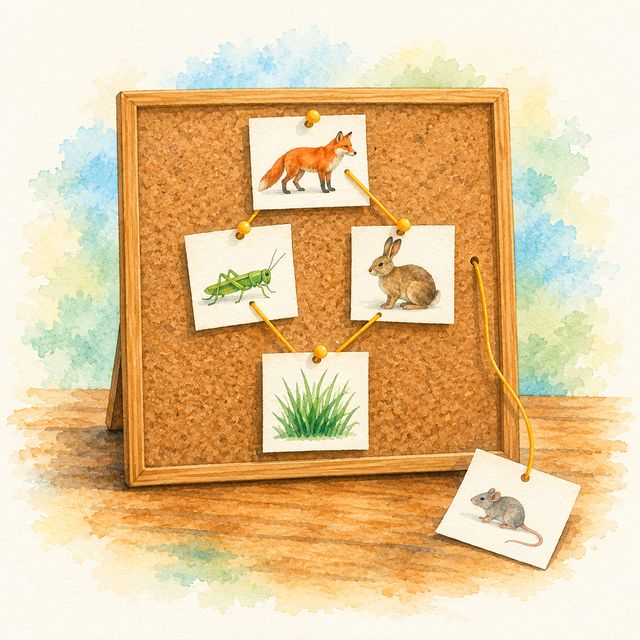
Your child reads a food web and follows what changes when one plant or animal is taken out.
Your child reads a meadow's food web, a simple model of nine plants and animals, and checks four things the Pet believes about it: who eats whom, which way the arrows point, what changes when one is taken out. If an answer does not fit, the Pet says why from the arrows.
- Grades 5–6 and 7–8
- 15 min
- Nothing to prepare
- On the screen
Free to sign up.
Is it a good fit?
- Ready if Your child knows what a few garden or park animals eat.
- Too much today? Start with Who lives here?: who lives in one place and the food chain that joins them.
- Too easy? The Grade 7–8 level: an arrow drawn backwards, a meadow with no foxes run for three seasons, and how little of the sun's energy reaches the top.
What your child practises
- Reading a food web
- Energy passing from food to eater
- Predicting a change two steps away
- About a tenth up each step (Grade 7–8)
“No foxes means more rabbits, so less grass. It goes two steps.”
If your child says something like this, in their own words, the idea has landed. Finishing the rounds means they took part; this is the learning.
Your part
- Nothing for the game itself
- Each question has a Read it to me button
Take it off the screen (optional)
Draw a web for your own garden or park together, then cover one plant or animal with a finger and say what changes.
More like this
The full design
What it is
Everything in a food web is joined, so pull one member out and the change spreads. Skill: reading a food web (the arrows go from the food to the eater, the way the energy goes); following a change one and two steps along it; how little energy reaches the top.
How it goes
The Pet's claim sits over the web. Your child answers on the web: three cards checked together, a tap on an arrow, or a choice of three. An answer that does not fit gets the Pet's reason from the web's own arrows. Four questions make a game.
The Pet
It believes something the web does not say, never your child: "Everything in a meadow eats grass. Even the fox!" It asks your child to follow the arrows, and when a question is answered it says what the web showed. Its dare is the next step up: at 5–6, pull a hunter out and follow it two steps; at the top, a web drawn for your own garden or park, with one member pulled out.
By band
One web, nine members: grass and seeds; a grasshopper, a rabbit and a mouse; a frog; a fox, an owl and a hawk. 5–6 builds the chain into a web: what the rabbit, the mouse and the frog each eat; which way the grass and rabbit arrow points, and why; what the frog needs though it never eats it (grass, two steps back); the owls in a year with no mice. 7–8 pulls one out: the one arrow drawn backwards; no foxes, with rabbits, mice and grass predicted up, down or the same, then three seasons run; whether the grass gains (it loses, two steps down); and about a tenth of the energy passing up each step, so 10,000 units in the grass leave about 10 for the hawk.
What it grows
The science standards ask a Grade 5 child to model how matter and energy move among plants and animals, and that an animal's food energy was once the sun's (NGSS 5-LS2-1, 5-PS3-1); and a middle-school child to model energy flowing through an ecosystem and to predict how a change to one population affects the others (MS-LS2-3, MS-LS2-4). About a tenth per step is the rule of thumb the textbooks teach, and the game says "about".
Done, and what counts as evidence
Done means the four questions on the web answered. "Followed a change two steps" is an observation you may keep. The best record is off the screen: a web drawn of your own garden or park.
What's personal
Nothing: the meadow is a model, and the memo says so. No family facts are used.