Science · Grades 5–6 and 7–8
The moths on the tree
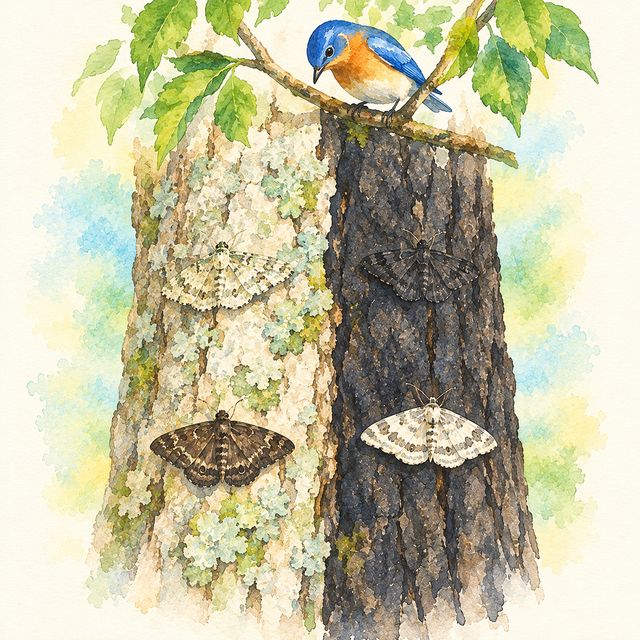
Your child sees where a moth's colour comes from and how the birds change a whole population over the years.
Your child looks at a drawn tree with four moths and a bird, and checks four things the Pet believes, by sorting cards, tapping the moth a bird would spot, or choosing an answer. At Grade 7–8 soot darkens the bark, your child predicts what happens, and thirty generations run on the screen.
- Grades 5–6 and 7–8
- 15 min
- Nothing to prepare
- On the screen
Free to sign up.
Is it a good fit?
- Ready if Your child knows that young animals look like their parents.
- Too much today? Start with Who lives here?: animals and the places they live, before how a population changes.
- Too easy? The Grade 7–8 level: soot on the bark, thirty generations, the clean air, and what adapted means.
What your child practises
- Inherited and learned traits
- Camouflage
- Natural selection over generations (Grade 7–8)
“It came from its parents.”
If your child says something like this, in their own words, the idea has landed. Finishing the rounds means they took part; this is the learning.
Your part
- Nothing for the game itself
- Each question has a Read it to me button
- Nothing about your child is asked or kept
Take it off the screen (optional)
On a walk, look for an animal whose colour hides it: a bird on a branch, an insect on a leaf. What would happen if its background changed colour?
More like this
The full design
What it is
The colour that hides gets passed on. Skill: inherited and learned traits; camouflage; how the birds decide which moths live to have young; a population changing over generations while no single moth changes.
How it goes
The Pet's claim sits under the tree. Your child sorts three cards and checks them, taps a moth on the tree, or chooses from three. A moth that hides gets why it is hard to see; every other miss has its own reason.
The Pet
It believes something the tree does not show, never your child: "The moths turned themselves dark to hide. Clever moths!" When a round is answered it says what the tree showed. Its dare is the next step up: at 5–6, what soot does to the moths; at the top, find an animal near you whose colour hides it, and say what would happen if its background changed.
By band
One drawn tree trunk with four moths on it and a bird on a branch. 5–6: sort three things as inherited or learned (a moth's wing colour, a kitten's stripes, a dog sitting when told); tap the moth the bird would spot first on clean pale bark (the dark one); which colour is left more after a summer of birds (pale); what colour two pale moths' babies are (pale, like their parents). 7–8: soot darkens the bark, and the child predicts more, fewer or the same for pale moths, dark moths and one moth's own colour (fewer, more, the same), then watches thirty generations run as two bars; why the dark moths became most of them (birds ate more pale ones, so dark ones lived to have young); what happens when the bark turns pale again (dark moths become fewer); what "adapted" means here (the group changed over generations, no single moth did).
What it grows
The science standards ask a middle-school child to explain how natural selection leads to more of the traits that help survival in a given environment (NGSS MS-LS4-4, MS-LS4-6) and that offspring inherit traits from their parents (MS-LS3-2); England's national curriculum asks a Year 6 child to recognise that offspring vary and are not identical to their parents, and that animals are adapted to their environment, which may lead to evolution. The peppered moth's rise and fall is the record; the numbers on the bars are a model, and the game says so.
Done, and what counts as evidence
Done means the four rounds answered. "It came from its parents" and "the survivors passed it on" are observations you may keep. The best record is off the screen: your child explaining to someone at home why the dark moths rose and fell.
What's personal
Nothing. The tree and the moths are drawn; nothing about your child or the family is asked or kept.