Science · Grades 5–6 and 7–8
Read the rocks
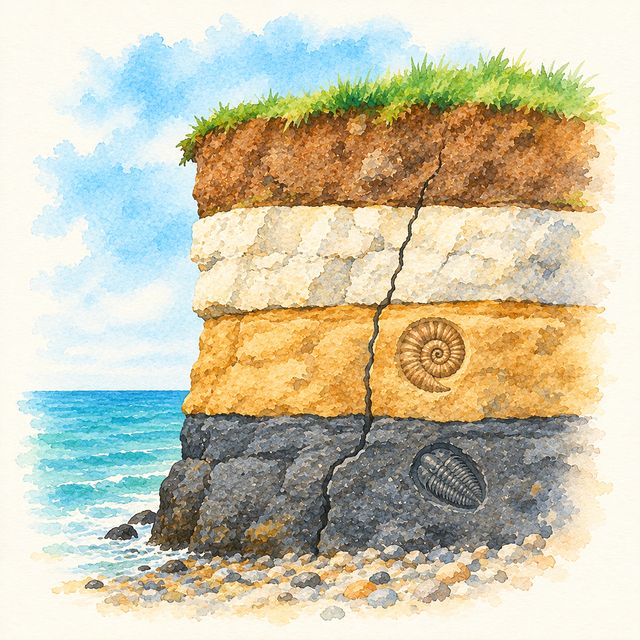
Your child reads a cliff of rock layers from the bottom up and sees what the fossils and the rocks say about Earth's past.
Your child reads a drawn cliff of four rock layers, each with a fossil, and checks four things the Pet believes, by tapping the layers in order, tapping a fossil, sorting rocks, or choosing an answer. At Grade 7–8 a crack runs through the layers, and your child sets it in time.
- Grades 5–6 and 7–8
- 15 min
- Nothing to prepare
- On the screen
Free to sign up.
Is it a good fit?
- Ready if Your child knows that a fossil is the remains of something that lived long ago.
- Too much today? Start with The moths on the tree: how living things change over generations, before the record in the rock.
- Too easy? The Grade 7–8 level: the crack set in time, how long a layer took, the rock cycle, and what the fossils show.
What your child practises
- The order of rock layers
- Fossils as a record
- The three kinds of rock and the rock cycle
- Setting events in order (Grade 7–8)
“The bottom one was there first.”
If your child says something like this, in their own words, the idea has landed. Finishing the rounds means they took part; this is the learning.
Your part
- Nothing for the game itself
- Each question has a Read it to me button
- Nothing about your child is asked or kept
Take it off the screen (optional)
Look at a wall, a road cutting or a layered cake together. Which part went on first, and how can you tell?
More like this
The full design
What it is
Rock is a record, read from the bottom up. Skill: the order of rock layers (the lowest is the oldest); fossils and what they say about when and where things lived; the three ways rock forms and the rock cycle; what cuts through layers is younger than they are.
How it goes
The Pet's claim sits under the cliff. Your child taps the layers in order, taps a fossil, sorts three cards and checks them, or chooses from three. A layer tapped too soon is told what comes first and stays to tap; every other miss has its own reason.
The Pet
It believes something the cliff does not show, never your child: "The biggest fossil must be the oldest. Look at that fish!" When a round is answered it says what the cliff showed. Its dare is the next step up: at 5–6, when a crack in the rock happened; at the top, find layers near you, in a wall, a road cutting or a cake, and say which went on first.
By band
One drawn cliff of four layers (dark shale, sandstone, pale limestone, brown mudstone), a fossil in each (a trilobite, a coiled sea shell, a big fish, a leaf). 5–6: tap the layers oldest first; tap the oldest fossil (the trilobite at the bottom, not the biggest); what sea shells high in a cliff show (the rock formed under the sea); sort sandstone, basalt and marble by how they formed (settled, cooled from melted rock, squeezed and heated). 7–8, the cliff now with a crack through the lower three layers and the top layer lying across it unbroken: tap what happened first to last (the three layers, the crack, the top layer); mud settling 1 mm a year, how long for 10 cm (about 100 years); a granite mountain wearing away (its sand settles into new rock); trilobites low down and a leaf at the top (they lived at different times, and trilobites died out).
What it grows
The science standards ask a middle-school child to construct an explanation from rock layers for how Earth's history is organised (NGSS MS-ESS1-4), to describe the cycling of Earth's materials (MS-ESS2-1), and to use the fossil record as evidence of life changing and dying out over time (MS-LS4-1); at 5–6 the rock cycle and the three kinds of rock come before. England's national curriculum asks a Year 3 child to compare rocks and describe how fossils form, and a Year 6 child to recognise that fossils tell us about living things that inhabited the Earth millions of years ago. The cliff is drawn and the settling rate is a model's number, and the game says so.
Done, and what counts as evidence
Done means the four rounds answered. "The bottom one was there first" and "what cuts through is younger" are observations you may keep. The best record is off the screen: your child reading real layers and saying which went on first.
What's personal
Nothing. The cliff is drawn; nothing about your child or the family is asked or kept.