Science · Kindergarten to Grade 3–4
Plant-eater or meat-eater? (dinosaurs)
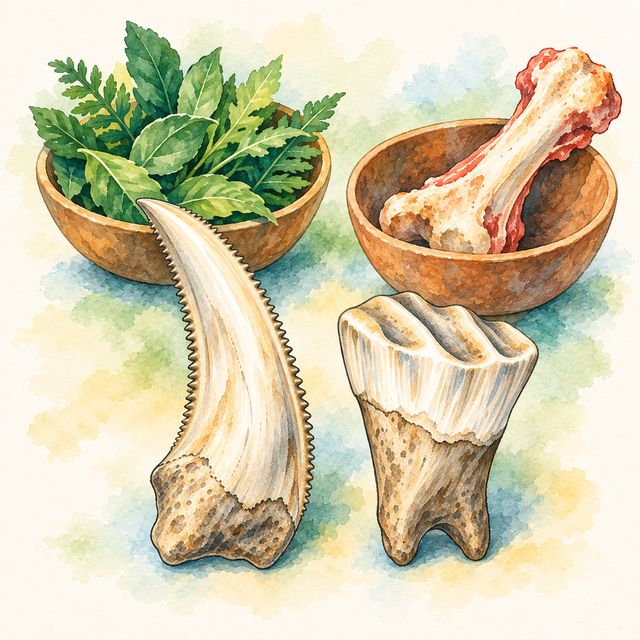
Your child reads a dinosaur's teeth to find its dinner.
Your child looks at a dinosaur's teeth and taps whether it ate leaves or meat. Older children see only the tooth and explain how they know.
- Kindergarten to Grade 3–4
- 10 min
- Nothing to prepare
- On the screen
Free to sign up.
Is it a good fit?
- Ready if Your child can look closely at a picture and tell pointed teeth from flat ones.
- Too much today? Start with Meat, or plants?: the same teeth clue on animals alive today.
- Too easy? The Grade 3–4 level: one fossil tooth alone on the screen, what it ate and how you know.
What your child practises
- Sorting by teeth
- Giving a reason
- Reading a clue from a fossil
“Flat teeth grind leaves, so it ate plants.”
If your child says something like this, in their own words, the idea has landed. Finishing the rounds means they took part; this is the learning.
Your part
- Nothing needed; a mirror for the dare if your child wants one
- Each question has a Read it to me button
- Plays alone, with you welcome at Kindergarten
Take it off the screen (optional)
Take the Pet's dare: look at your own teeth in a mirror, flat at the back and pointed at the front, and say what that makes you.
More like this
The full design
What it is
A dinosaur's teeth say what it ate, and a child can read them. Pointed and serrated teeth cut meat. Flat and ridged teeth grind leaves. Your child sorts dinosaurs into two groups by looking, then says why, and by 3 to 4 the dinosaur is taken away and only the tooth is left: what ate this, and how do you know? That is the structure-and-function idea in its strongest form, and it works on animals alive today too, which is where the round ends.
How it goes
Two bowls on the screen, one of leaves and one of meat, and a dinosaur between them. Your child taps a bowl. A right tap gets the reason back in the Pet's words. A wrong tap gets the tooth enlarged and a question: "Look at the edge. Could that cut?" At 3 to 4 the round inverts: only the tooth, then the answer, then the reason from three, one of which is true but not about teeth, so a guess is visible to the child themselves.
The Pet
Asks the question in five words. Notices the reason rather than the answer: "You said flat teeth grind. That is the whole rule." Admits the awkward truth at 3 to 4: some ate both, and a few are still argued about, so "we are not sure" is on the screen as a real third answer and not a trap. Remembers the animals your child has already met elsewhere. Dares: look at your own teeth in the mirror, flat at the back and pointed at the front, and say what that makes you.
By band
K: sort six dinosaurs into two groups by the teeth on the picture, no reason asked. 1 to 2: the same sort, and then the reason chosen from two ("flat teeth grind leaves" or "pointed teeth cut meat"), plus the second clue, the feet: claws for gripping, hooves and pads for walking on. 3 to 4: one fossil tooth alone on the screen, your child says what it ate and why, and then the harder pair, an animal alive now with the same teeth, so the rule is about bodies and not about dinosaurs.
What it grows
Teeth and feet are the child-readable evidence the sources use, and they carry 1-LS1's structure and function directly: a body part is for something. The misconception this game is built to avoid is treating the fossil as the animal: what is on the screen at 3 to 4 is a record left behind, and the Pet says that in those words.
Done, and what counts as evidence
Done = the rung's sorts made. The evidence is the reason, not the sort: at 1 to 2 and up the Parent's record keeps which rule your child chose and whether it matched the teeth, because a right group with the wrong reason is the thing worth seeing. At 3 to 4 the evidence is the tooth round, where nothing but the tooth was on the screen.
What's personal
The comparisons at 3 to 4 are drawn from the animals your child has already placed in other games, so the giraffe they know comes back as the flat-toothed grinder. Nothing new is stored: the game reads what is already there and writes only which dinosaurs were sorted and which reason was chosen.