Science · Pre-K to Grade 1–2
Big and small (dinosaurs)
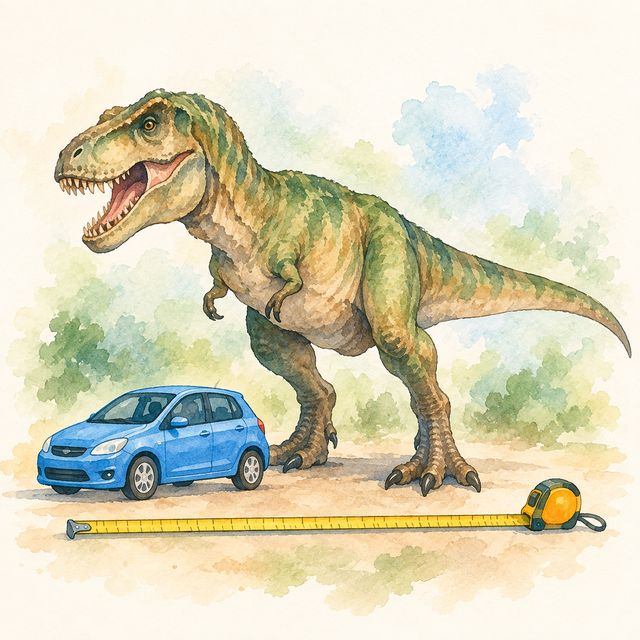
Was a dinosaur bigger than your car? Your child finds out.
A dinosaur stands beside something your child knows, like the car or the front door, and they pick which is bigger. From Grade 1–2 they measure a dinosaur's length down the hallway with a tape or their own steps.
- Pre-K to Grade 1–2
- 10 min
- Nothing to prepare
- On the screen
Free to sign up.
Is it a good fit?
- Ready if Your child can look at two pictures and tell you which thing is bigger.
- Too much today? The Pre-K level: two pictures, one tap, and which is bigger.
- Too easy? The Grade 1–2 level: a Tyrannosaurus measured down the hallway, in steps or with a tape.
What your child practises
- Bigger or smaller
- Putting in order
- Measuring with steps or a tape
“The Tyrannosaurus would not even fit in our house!”
If your child says something like this, in their own words, the idea has landed. Finishing the rounds means they took part; this is the learning.
Your part
- Nothing to prepare for the screen; a tape or a ball of string at Grade 1–2
- Each question has a Read it to me button
- Alone at Pre-K; at Grade 1–2 you hold the tape in the hallway
Take it off the screen (optional)
Take the Pet's dare: find something in the house about the size of the smallest dinosaur, as small as a chicken.
More like this
The full design
What it is
A dinosaur stands next to something your child knows the size of: your cat, the car, the front door, their school bag. Which is bigger? That is the whole question at Pre-K, and it is the beginning of measuring: comparing two things directly before any number is involved. By 1 to 2 the comparison leaves the screen. A Tyrannosaurus was about twelve metres from nose to tail, so your child lays the tape down the hallway, or counts their own steps, and finds out that it did not fit in the house. The dinosaur is the hook. Comparing, ordering and measuring in your own units is the learning.
How it goes
Two painted dinosaurs, or one dinosaur and one home thing, side by side at the sizes they really are relative to each other, and one question. A tap gives the answer with the reason, never a bare right: "Yes. The bus is longer than the Stegosaurus, but not by much." A wrong tap gets a question back, not a cross: "Look at the tail. Where does it end?" At 1 to 2 the round opens onto the floor: the screen goes down, the tape comes out, and one tap says how many steps it took. Your child's own number is kept and read back the next time they play.
The Pet
Asks the comparison in the fewest words that get a finger moving. Notices the measure, not the answer: "Eighteen of your steps. You measured it yourself." Remembers the number across sittings: "Last time the hallway was eighteen steps. Is it still?" Dares at K and up: find something in the house the size of the smallest dinosaur on the screen. Admits what nobody knows: the sizes of some of these are estimates from a few bones, and the Pet says so at 1 to 2 rather than pretending.
By band
Pre-K: two pictures, one tap, "which is bigger?", with the yardstick always a thing from home. K: three things put in order, smallest to biggest, and the first non-standard unit ("how many cats long is the Stegosaurus?"). 1 to 2: the real measure, off the screen. Twelve metres of hallway in steps or in tape, then the smallest of them: Compsognathus was about the size of a chicken, so your child finds something that size in the house and holds it.
What it grows
Pre-K and K measurement is direct comparison and then non-standard units, which is exactly "how many cats long?"; standard units come later. The dinosaur set carries the motivation and the standards ride on it: K-LS1 and 1-LS1 for what bodies are for, 2-ESS1 for slow and fast change. The two sizes this game states as numbers are the two the sources give plainly, a Tyrannosaurus at about twelve metres and a Compsognathus at about the size of a chicken; every other size in the data module lands with its source beside it, as the animal pack's rows do.
Done, and what counts as evidence
Done = the rung's comparisons made. The evidence is at 1 to 2 and it is off the screen: the hallway measured in a unit your child chose, and the thing they found that is the size of a Compsognathus. A photograph of the tape stretched down the hall is the work sample, on the Parent's side, and the Pet never asks for it.
What's personal
The yardsticks are yours: your child picks which home things stand beside the dinosaurs from a short list, and the list is generic paintings, never a photograph of your house. The steps counted are your child's own steps in your own hallway, kept as their number and never compared with another child's. Nothing about the size of your home is stored: the number of steps is a measure of the child's stride as much as of the hall.