Geography · Grade 3–4 to Grade 7–8
Where did this come from?
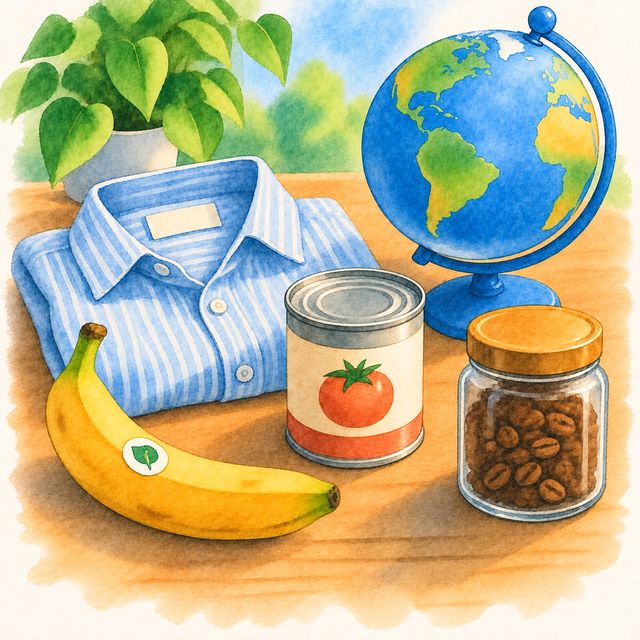
The world is in your kitchen: every label is a place, and your child finds it on the map.
Your child hunts the kitchen and cupboards for labels that say where things were made. Each place goes on the world map with a line back to your home.
- Grade 3–4 to Grade 7–8
- 15 min
- Kitchen things
- On the screen
Free to sign up.
Is it a good fit?
- Ready if Your child can read a short label and knows a few continents' names.
- Too much today? Start with Where in the world is Pip?: finding a country's continent from clues, with no label to read.
- Too easy? The Grade 7–8 level: how each thing travelled, and how much further one came than another.
What your child practises
- Reading a label
- Continents on a world map
- Distance from home
- Why things grow where they do
“The bananas came all the way from South America, on a ship.”
If your child says something like this, in their own words, the idea has landed. Finishing the rounds means they took part; this is the learning.
Your part
- Nothing to print: three things from your own cupboards
- Each question has a Read it to me button
- Alone, or with whoever is unpacking the shopping
Take it off the screen (optional)
Check the labels in one shopping bag together, and guess where each came from before you read it.
More like this
The full design
What it is
The world is already in your kitchen. The sticker on the banana, the label in a shirt, the small print on a jar: each one names a place, and each place goes on the map with a line back to your home. The questions then get bigger: how far, why there, and how it got here.
How it goes
The Pet sends your child label-hunting, and waits while they look. They say what they found (a fruit, a jar, clothes, a toy, a phone), type the first letters of the country on the label and pick it from the list, then find its continent on the map; it lands with a line from home. Nothing is marked about the label: it says what it says. A place picked by mistake can be taken back with "Not that one". After three things, the Pet asks the question for their age.
The Pet
It notices: "Ecuador is in South America. There it goes, with a line from home." When your child is stuck it asks one question ("where is Ecuador? think of what is near it"), then lights the continent. If the hunt is the trouble, it lends one of its own things, said as its own: its banana from Ecuador, its T-shirt from Bangladesh, its tea from India.
By band
3–4: find three things with a country on them, find each country's continent on the world map, and say which came furthest from home. 5–6: the same three, and the game says about how far each one travelled; then "what is the weather like where your fruit grew?", and which came furthest. 7–8: the same three with their distances; then how the one from furthest across the sea most likely travelled, by ship, plane or lorry, and how much further the furthest came than the nearest. The Pet's dare at 7–8 is the big question: find one thing in the kitchen that grew within 100 km, about 60 miles, of home.
What it grows
Children learn geography best when it starts with their own life and widens outward, self, then family, then the world beyond, and a real label in the hand is a stronger start than a map on a wall. Seeing that food travels, and why it comes from where it does, is the first step into how places depend on each other.
Done, and what counts as evidence
Done means three things placed. A line in your words does as a work sample: "found out bananas grow where it is warm all year".
What's personal
It is your family's food and clothes, so the map is a portrait of your household. Home on the map is your family's country as set for the family, not where the phone is. Distances are about, from the middle of one country to the middle of the other, in miles where your road signs say miles. If your country is not on the game's list, the map shows no home and no distances, and the game says so. Nothing is photographed.