Geography · Grades 5–6 and 7–8
What time is it there?
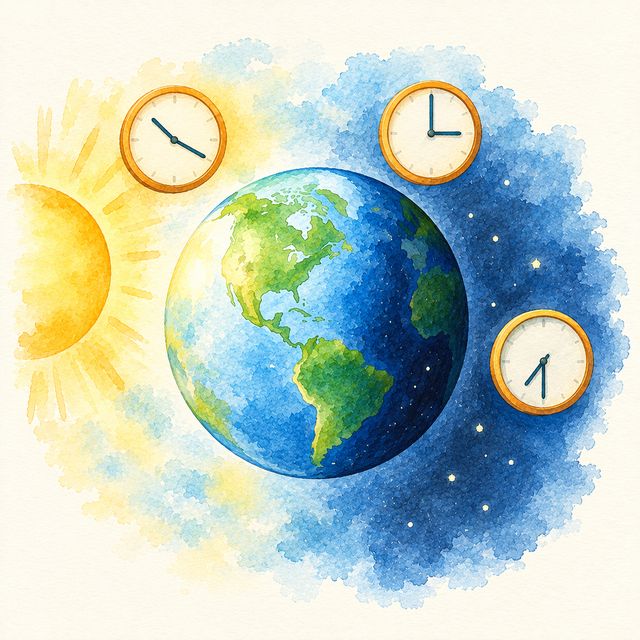
Your child works out what time it is on the other side of the world, and why.
Your child reads a map of the world in day and night, with five real cities, and checks four things the Pet believes, by tapping the cities that fit or choosing an answer. At Grade 7–8 your child finds where it is already tomorrow, plans a call across zones, and follows a flight that lands earlier than it left by the local clock.
- Grades 5–6 and 7–8
- 15 min
- Nothing to prepare
- On the screen
Free to sign up.
Is it a good fit?
- Ready if Your child can tell the time and add hours on a clock.
- Too much today? Start with Time-zone call: day and night with a torch and a ball, and the people your family knows abroad.
- Too easy? The Grade 7–8 level: already tomorrow, a call across zones, the flight that lands earlier, and zigzag zones.
What your child practises
- Day and night on a turning Earth
- Working out the time somewhere else
- The date line (Grade 7–8)
- Planning across time zones (Grade 7–8)
“East is ahead.”
If your child says something like this, in their own words, the idea has landed. Finishing the rounds means they took part; this is the learning.
Your part
- Nothing for the game itself
- Each question has a Read it to me button
- Nothing about your child is asked or kept
Take it off the screen (optional)
Pick someone you know who lives far away. What time is it there now, and are they awake?
More like this
The full design
What it is
The Earth turns, and the east meets the morning first. Skill: day and night on a turning Earth; 15 degrees an hour; working out the time in another place; the date line; time zones as a choice countries make.
How it goes
The Pet's claim sits under the map. Your child taps every city that fits, or chooses from three. A city that does not fit says why, with the hours worked out; every other miss has its own reason.
The Pet
It believes something the map does not show, never your child: "A plane can't land before it took off!" When a round is answered it says what the map showed. Its dare is the next step up: at 5–6, find where it is already tomorrow; at the top, pick a city where someone you know lives, or one on the news, and say what time it is there now.
By band
One strip of the world, the Sun over the place where it is noon, the night worked out from the hour, and five cities: Honolulu, Bogotá, Lagos, Dubai and Tokyo. 5–6: tap every city where it is night (Honolulu and Tokyo); why the Sun seems to cross the sky (the Earth turns); Bogotá or Lagos, who sees sunrise first (Lagos, further east, 6 hours ahead); how far the Earth turns in an hour (15 degrees). 7–8: Lagos says Monday 8 pm, tap the city where it is already Tuesday (Tokyo, 4 am); a call from Bogotá to Dubai with both awake (8 am in Bogotá, 5 pm in Dubai); a 7-hour flight leaving Tokyo at 6 pm lands at 6 am Honolulu time, earlier the same date; why time zone lines zigzag (countries choose their clocks).
What it grows
The C3 Framework asks a child to explain how the Earth's turning gives time zones (D2.Geo, 3–5) and, at 6–8, to plan across them; England's national curriculum asks a Key Stage 2 child to understand latitude, longitude and time zones, including day and night. The five cities keep one clock all year, so no answer changes with summer time (the research note of Time-zone call); the day and night strip is a model with no seasons, and the game says so.
Done, and what counts as evidence
Done means the four rounds answered. "East is ahead" and "they are 9 hours ahead, so it is 5 pm there" are observations you may keep. The best record is off the screen: your child working out what time it is now where someone you know lives.
What's personal
Nothing. The cities are fixed and real; no relative, home town or family detail is asked for or kept (the family's people stay in Time-zone call).