Geography · Grade 3–4
Puzzle map
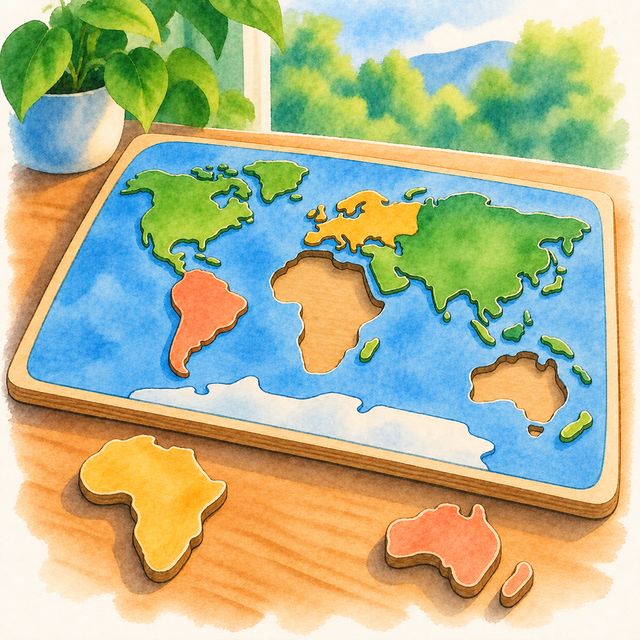
Your own country, piece by piece, with a reason for each.
Six pieces of your own country are missing from the map, and your child puts each one where its shape fits. Then they pick a true reason it goes there, like a neighbour or a coast.
- Grade 3–4
- 10 min
- Nothing to prepare
- On the screen
Free to sign up.
Is it a good fit?
- Ready if Your child knows which country you live in and can match a shape to its outline.
- Too much today? Start with Animal atlas: the continents first, one tap at a time.
- Too easy? The countries of one continent, then the world by region, are planned; until their maps are ready every child plays your own country.
What your child practises
- Shapes of regions
- What is next to what
- Giving a reason
- Checking the Pet's claim
“Nova Scotia is next to New Brunswick, and it has a coast.”
If your child says something like this, in their own words, the idea has landed. Finishing the rounds means they took part; this is the learning.
Your part
- Nothing to prepare or print
- Each question has a Read it to me button
- Plays alone from Grade 3–4; sit nearby if the region names are new to your child
Take it off the screen (optional)
Find today's regions on a paper map of your country, or the one on the wall, and ask your child to say the biggest one's capital to you.
More like this
The full design
What it is
Your own country, in pieces. Most of it is already on the map; six pieces are out today, and your child puts each one where its shape fits, then says why it goes there: next to this one, by the sea, the biggest, on its own as an island. The placing is the fun; the reason is the geography. A child who can say "Nova Scotia is next to New Brunswick, and it has a coast" has a map in their head, which is the skill this grows.
How it goes
The piece appears in a box beside the map, big enough to see its shape, with its name read aloud. Your child taps the outline on the map where it fits. A tap on the wrong place says what was tapped and gives one clue ("what is New Brunswick next to? Quebec."), because the map has no names on it, and any region can be tapped at any time to hear its name. When the piece is in, three or four reasons appear, in a different order each day, and one of them is not true of that piece: pick a true one and the notebook writes it down; pick the false one and the Pet asks you to look at the map again. Four pieces for your child, then two for the Pet: it puts its piece down in its own colour and says why, and your child judges it, Right or Not right. Six pieces make a session; the next day brings six different ones.
The Pet
It notices how the piece was found ("you used the coastline"). It asks rather than tells: what is it next to, where is the coast, and when the quiet goes on it lights the outline it means. On its own turn it is wrong on purpose, once, and says so when caught: "You caught me. Yukon is not next to Alberta." Its dare at the end is to name the capital of the biggest region and say it to a grown-up before the screen shows it. Remembering the piece your child hesitated on is designed and not built yet.
By band
Today every child plays the country rung (3–4): the provinces, states, regions or emirates of the family's own country. The continents and oceans (1–2), the countries of one continent (5–6) and the world by region with only the lines of latitude to go by (7–8) are designed and wait for their maps; until then a younger or older child plays the country too.
What it grows
Puzzle maps teach the shapes of places, but the learning is in the explaining: a child who says why a piece goes there is building relative position, the thing a mental map is made of. Being allowed to correct the Pet is the same skill from the other side: to say "not right" you have to read the map yourself.
Done, and what counts as evidence
Done = the day's six pieces placed and judged. Nothing is timed and no score is kept. The notebook on the screen holds the reasons in your child's words ("Nova Scotia: by the sea"), and those are the evidence: a reason said out loud is a piece of map your child owns.
What's personal
The country is yours, from the family settings: the regions' names, their capitals, their coasts and, where we have checked them, their neighbours, drawn from real map data. A family in Canada gets the provinces and territories; in the UK the four countries; in Spain the comunidades. If your country has no map here yet, the game says so and plays Canada's for now. The Pet is the one your child named.