Science · Grades 5–6 and 7–8
Our week of rubbish
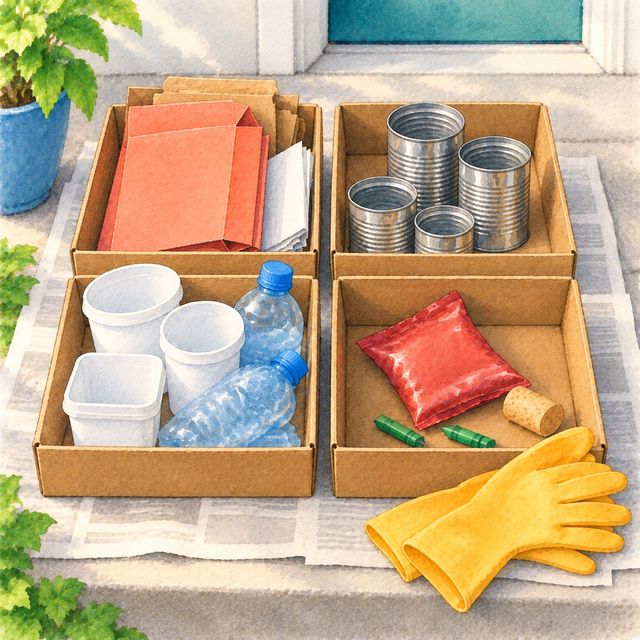
A week of your household's rubbish, sorted and counted by your child, and one change proposed with the numbers.
Your child collects a week's clean, dry rubbish in a box, sorts it into four trays, counts or weighs each, charts it, and proposes one change. At 7–8 the family tries it and they measure again.
- Grades 5–6 and 7–8
- 60 min
- A printout
- On the screen
Free to sign up.
Is it a good fit?
- Ready if Your child can read kitchen scales or count to a hundred.
- Too much today? The 5–6 level: one week, sorted and charted.
- Too easy? The 7–8 level: a change kept, and measured again.
What your child practises
- Sorting and counting
- A bar chart
- Arguing from evidence
“Most of it was plastic pots, so we could buy the big tub instead.”
If your child says something like this, in their own words, the idea has landed. Finishing the rounds means they took part; this is the learning.
Your part
- Agree to the week as a family
- Check the box before your child sorts it
- Try the change they propose
What you need
From home
- A big box for the week's clean rubbish
- Four trays or shallow boxes
- Newspaper to work on
- Rubber gloves
- Kitchen scales
- A pencil, a ruler and paper
The steps
Grade 5–6
 Agree with the family: for a week, everything clean and dry you throw away or recycle goes in the big box. No glass, batteries or sharp lids. Flatten boxes.
 Agree with the family: for a week, everything clean and dry you throw away or recycle goes in the big box. No glass, batteries or sharp lids. Flatten boxes.
The other 4 steps, each with its painting, are in the Family portal.
It must pass: You sorted and counted a week's rubbish, and proposed one change the family can keep, with your numbers.
Grade 7–8
- Agree with the family: for a week, everything clean and dry you throw away or recycle goes in the big box. No glass, batteries or sharp lids. Flatten boxes.
The other 5 steps, each with its painting, are in the Family portal.
It must pass: You proposed one change with your numbers, the family kept it for a week, and you measured whether it worked.
Safety
Only clean, dry things go in the box, never food, and you check it before your child sorts: nothing broken, no glass, no batteries, no aerosols, no cleaning or medicine bottles, no sharp tin lids (push them inside the tin or tape them), nothing from a bathroom bin, no nappies. Gloves on for the sorting, and everyone washes their hands after.
Where the facts come from
More like this
The full design
What it is
For one week, the family's clean, dry rubbish goes into a big box instead of the bin. At the end of the week your child sorts it into four trays, paper and card, tins, plastic and everything else, weighs all four or counts all four, draws a bar for each, and proposes one change the family could keep, aimed at the biggest tray, with the numbers to back it. The screen shows one step at a time as a painting of that step and asks at the end.
How it goes
One step fills the screen: the painted plate of that step, the words under it, and two buttons. The steps fall across a week, or two at 7 to 8. Done this step moves on; skip it also moves on, and the finish says how many were skipped. At the end, Show asks what is true (I know the biggest tray, the family tried it), and What I learned asks the band's question.
The Pet
Asks at each step: "One change, for the biggest tray. Show your numbers." Notices: "Proposed, with the evidence." Remembers across the week. It never judges what a family throws away.
By band
5 to 6: a week collected, sorted, counted, charted, and a change proposed. 7 to 8: the family keeps the change for a week, and your child sorts and counts again to see whether it worked.
What it grows
Fifth-grade science asks how communities use science to protect resources; the third-grade data standard asks for data shown in a bar graph. Service-learning studies found gains in attitudes and social skills, though few with children this age, so the claim here is only that your child measures something real and argues from it.
Done, and what counts as evidence
Done = the steps done or honestly skipped, and one line chosen at the end. The evidence is the four numbers and the chart, and the change proposed from them; at 7 to 8, the second week's numbers beside the first.
What's personal
What your family throws away is never typed or stored: the numbers stay on your paper, and only your child's answers are stored, as their answer, not as a mark. A material you do not have is named once, a substitute is offered, and the project carries on.