Reading · Pre-K to Grade 3–4
A sock puppet and a two-minute show
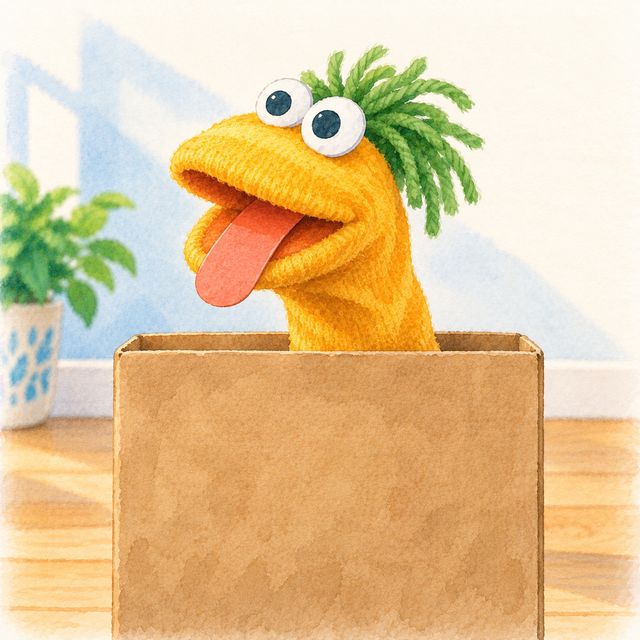
A sock puppet your child made, and a show they put on for you.
Your child gives an old sock eyes, a tongue and hair, names it, and puts on a show from behind a box. From 1–2 the show has a start, a problem and an end.
- Pre-K to Grade 3–4
- 30 min
- A printout
- On the screen
Free to sign up.
Is it a good fit?
- Ready if Your child can glue a paper shape on and say a few words in a made-up voice.
- Too much today? The Pre-K level: hello, one thing, goodbye.
- Too easy? The 3–4 level: two characters and a two-minute story.
What your child practises
- Telling a story
- Speaking in front of others
- Planning in three parts
“The problem was the dog lost its ball, and at the end it found it.”
If your child says something like this, in their own words, the idea has landed. Finishing the rounds means they took part; this is the learning.
Your part
- Find an old clean sock, coloured and white paper, a piece of card, white glue and some wool
- Cut the pieces at Pre-K and K
- Be the audience, and time it at 3–4
What you need
From home
- An old clean sock, and a second one at 3–4
- Paper and card: coloured paper, white paper, a piece of thin card for each sock, a felt pen and a pencil
- Blunt scissors
- White glue
- A few pieces of wool
- A big cardboard box
The steps
Pre-K
 Cut two coin-sized circles from white paper for eyes, and draw a dark dot in each. Cut a long tongue, as long as your hand, from coloured paper. (A grown-up does this step)
 Cut two coin-sized circles from white paper for eyes, and draw a dark dot in each. Cut a long tongue, as long as your hand, from coloured paper. (A grown-up does this step)
The other 5 steps, each with its painting, are in the Family portal.
Kindergarten
- Cut two coin-sized circles from white paper for eyes, and draw a dark dot in each. Cut a long tongue, as long as your hand, from coloured paper. (A grown-up does this step)
The other 5 steps, each with its painting, are in the Family portal.
Grade 1–2
- Cut two coin-sized circles from white paper for eyes, and draw a dark dot in each. Cut a long tongue, as long as your hand, from coloured paper.
The other 5 steps, each with its painting, are in the Family portal.
It must pass: The show has a start, a problem and an end.
Grade 3–4
- Cut two coin-sized circles from white paper for eyes, and draw a dark dot in each. Cut a long tongue, as long as your hand, from coloured paper.
The other 5 steps, each with its painting, are in the Family portal.
It must pass: The show has a start, a problem and an end, two characters, and lasts about two minutes.
Safety
At Pre-K and K you cut the eyes and the tongue; your child uses blunt scissors from 1–2. Use white school glue, and keep it away from mouths. Glue with the sock off and card inside it, never while it is on a hand. Use an old clean sock that nobody needs back.
Where the facts come from
More like this
The full design
What it is
An old sock with paper eyes, a paper tongue and wool hair becomes a character with a name and a voice, and puts on a show for the family from behind a big box stood on its end, or the sofa. From 1 to 2 the show is a story with a start, a problem and an end. The screen gathers the things, shows one step at a time as a painting of that step, and asks at the end. The puppet and the show are the make.
How it goes
One step fills the screen: the painted plate of that step, the words under it, and two buttons. Done this step moves on. Too hard, skip it also moves on, and the finish says how many were skipped without dressing it up. At the end, Show asks what is true (it has its own voice, someone laughed), and What I learned asks the band's question.
The Pet
Asks at each step: "Three boxes: the start, the problem, the end." Notices: "A whole story, told. Take a bow." Remembers across the two sittings, so the glue dries in between. It never judges the story: a problem that is silly is still a problem.
By band
Pre-K: you cut the eyes and tongue; your child glues them on with card inside the sock, adds hair, and once the glue is dry names the puppet and has it say hello, do one thing and say goodbye from behind a box or the sofa. K: the same, and the question at the end is what was hardest. 1 to 2: your child cuts the pieces and plans a three-part story in three drawn boxes. 3 to 4: a second puppet from a second sock, so two characters talk, and a show of about two minutes that you time.
What it grows
Early learning frameworks name telling a story with a beginning, a middle and an end as part of language from age 3 to 5. A trial of project-based learning with second graders found gains in literacy; a puppet show is a small project of that kind, with the family as its audience.
Done, and what counts as evidence
Done = the steps done or honestly skipped, and one line chosen at the end. The evidence is the show: at Pre-K and K a character that speaks, from 1 to 2 a story with its three parts, and at 3 to 4 two characters and a story told to time.
What's personal
The puppet's name and your child's answers are stored as their answer, not as a mark. The show itself is not recorded. A material you do not have is named once, a substitute is offered, and the make carries on.