Reading · Pre-K to Grade 3–4
Story order
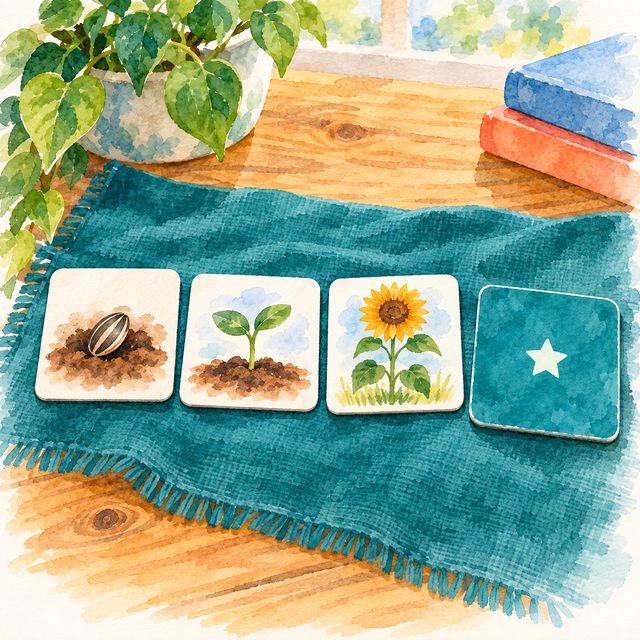
Your child puts a story they have read back in order and tells it in their own words.
Pages from a book your child has finished come up shuffled. Your child puts them in the order their reading went, then the story's words come back and they tell each part.
- Pre-K to Grade 3–4
- 5 min
- Nothing to prepare
- On the screen
Free to sign up.
Is it a good fit?
- Ready if Your child has finished at least one storybook.
- Too much today? The Pre-K level: three pages, the first, the middle and the last.
- Too easy? The Grade 3–4 level: six pages, and what would have changed with another choice.
What your child practises
- Remembering a story in order
- Telling it back
- First, next, last
“First Teta gave me a seed, then we planted it by the fence.”
If your child says something like this, in their own words, the idea has landed. Finishing the rounds means they took part; this is the learning.
Your part
- Nothing to prepare
- Best right after a reading, while the story is fresh
- Only books your child has finished appear
Take it off the screen (optional)
Ask your child to draw the three biggest moments of the story on three pieces of paper and put them in order.
More like this
The full design
What it is
Pages from a storybook your child has finished come up out of order, and your child puts them back in the order the story went: the way they read it, with the choices they made. Then, page by page, they tell what happened. It is retelling, the habit that turns a story heard into a story understood. A book your child has not finished is never shown here, so no page spoils an ending.
How it goes
The pages lie in a row, shuffled. Your child taps a page and then the place it goes (first, next, last). A page in the wrong place is "not yet", and the Pet points to the page that comes just before it. When all are in order, the story's own words come back under each picture, with the family's names in and a button that reads each aloud, and your child tells it; the round ends when they say they told it, never on a clock. One round per book, from the books your child has finished; with several finished books, two rounds, from two of them.
The Pet
Notices "you remembered the snail came before the rain!" Asks: it glows the first page, then asks "what happened right after the seed went in?", then places one page with your child. Remembers the choice your child made in the reading ("you picked the ring of stones"). Dares one more page, the next rung up.
By band
Pre-K: three pages, the first, one from the middle and the last. K: four pages. 1–2: five pages, and once they are in order your child says what happened on each, out loud. 3–4: six pages, and the Pet asks about the choice that changed the story: "what if you had picked the bird?" Older children play the 3–4 rung for now.
What it grows
Retelling a story in sequence is one of the earliest measures of understanding what was read; putting pictures in order is how children too young to write show that they have it.
Done, and what counts as evidence
Done = the pages in order and told. The order your child chose and what they said are not recorded; a grown-up who wants to keep a retelling can add it to the record themselves.
What's personal
The pages are the ones your child saw, in the order of their own reading: a child who chose the bee gets the bee's page, and one who chose the bird gets the bird's. With a grown-up who read it with them, it is a second conversation about the same book.