Science · Pre-K to Kindergarten
The dough table
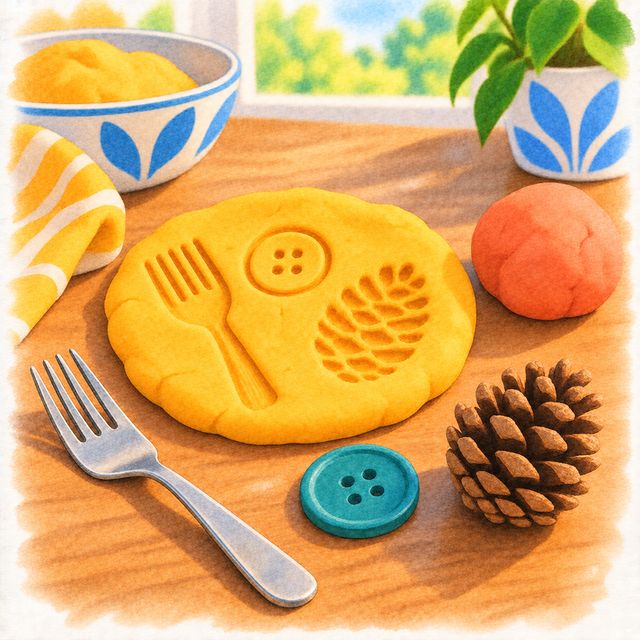
Prints your child pressed in play dough, and at K a print they read like a clue.
Your child squashes play dough flat and presses in a fork, a button and a pine cone, each leaving its own print. At K they guess, eyes shut, what made a print.
- Pre-K to Kindergarten
- 15 min
- Kitchen things
- On the screen
Free to sign up.
Is it a good fit?
- Ready if Your child can squash dough and press a thing into it.
- Too much today? The Pre-K level: three prints and a favourite.
- Too easy? The K level: the guessing game.
What your child practises
- Pressing and squashing
- Noticing textures
- Guessing from a clue
“The bumpy one was the pine cone.”
If your child says something like this, in their own words, the idea has landed. Finishing the rounds means they took part; this is the learning.
Your part
- Buy a tub of play dough
- Put out a fork, a big button and a pine cone
- Stay at the table
What you need
From home
- A fork
- A big button (small parts)
- A pine cone or a shell
- A cup, for rolling
- A board or a tray
From a local store
- Play dough from a shop
The steps
Pre-K
 Take half the dough. Squash it flat on the board with your hands, as thick as your finger, or roll it with the side of the cup.
 Take half the dough. Squash it flat on the board with your hands, as thick as your finger, or roll it with the side of the cup.
The other 4 steps, each with its painting, are in the Family portal.
Kindergarten
- Take half the dough. Squash it flat on the board with your hands, as thick as your finger, or roll it with the side of the cup.
The other 5 steps, each with its painting, are in the Family portal.
Safety
Use play dough from a shop. Homemade dough made from raw flour is not for children's play: raw flour can carry germs, so CDC advises against it. Nobody eats the dough, and everyone washes their hands after. The button is small: use a big one, stay at the table, and keep it from a toddler. Most play dough is made from wheat: for a child with a wheat allergy, buy one that is wheat-free.
Where the facts come from
More like this
The full design
What it is
A lump of play dough squashed flat on a board, and three ordinary things pressed into it, a fork, a big button and a pine cone, each leaving its own print. At K your child shuts their eyes while you press one of them into a second lump, and reads the print to guess what made it. The screen gathers the things, shows one step at a time as a painting of that step, and asks at the end.
How it goes
One step fills the screen: the painted plate of that step, the words under it, and two buttons. Done this step moves on. Too hard, skip it also moves on, and the finish says how many were skipped without dressing it up. At the end, Show asks what is true (the fork made lines, the cone made bumps), and What I learned asks the band's question.
The Pet
Asks at each step: "Press, then lift. Look at the marks." Notices: "Lines! The fork made lines." Remembers across a pause. It says the dough is for squashing, not eating.
By band
Pre-K: squash, press three things, keep the favourite print; with you at the table. K: the same, then the guessing game, a print read as a clue.
What it grows
Early learning frameworks name noticing and describing what things are like, rough, smooth, bumpy, as early science from age 3. A print in dough holds the texture still to look at, and guessing from it is reasoning from evidence at its smallest.
Done, and what counts as evidence
Done = the steps done or honestly skipped, and one line chosen at the end. The evidence is the prints, and at K the guess and how your child made it: a texture read back to the thing that made it.
What's personal
Your child's answers are stored as their answer, not as a mark. Nothing about your home is stored. A material you do not have is named once, a substitute is offered, and the make carries on.