Math · Pre-K to Kindergarten
Torn paper picture
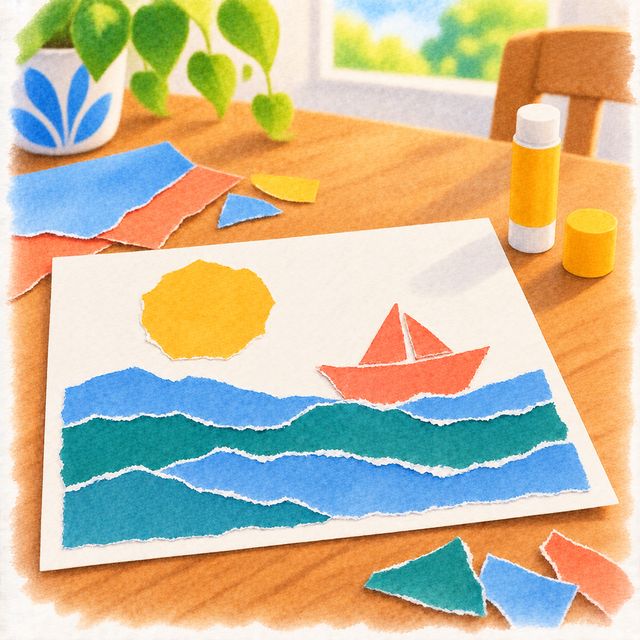
A torn paper picture your child made with their fingers, and can tell you about.
Your child tears coloured paper into strips and pieces and sticks them on a sheet as the sea or a garden, from the bottom up. No scissors.
- Pre-K to Kindergarten
- 15 min
- A printout
- On the screen
Free to sign up.
Is it a good fit?
- Ready if Your child can pinch a sheet of paper in both hands and tear it.
- Too much today? The Pre-K level: strips, sky and a sun.
- Too easy? The K level: one more shape, and the picture told from bottom to top.
What your child practises
- Tearing and sticking
- Above and below
- Describing a picture
“The sun is at the top and the boat is on the waves.”
If your child says something like this, in their own words, the idea has landed. Finishing the rounds means they took part; this is the learning.
Your part
- Put out blue-green, light blue, green, yellow and red paper, a white sheet and a glue stick
- Stay at the table at Pre-K
What you need
From home
- Coloured paper: blue-green, light blue, green, yellow and red
- A white sheet to stick it on
- A glue stick
The steps
Pre-K
 Choose the sea or a garden. Waves are blue-green, the ground green, the sky light blue, the sun yellow, and a boat or a flower red.
 Choose the sea or a garden. Waves are blue-green, the ground green, the sky light blue, the sun yellow, and a boat or a flower red.
The other 4 steps, each with its painting, are in the Family portal.
Kindergarten
- Choose the sea or a garden. Waves are blue-green, the ground green, the sky light blue, the sun yellow, and a boat or a flower red.
The other 5 steps, each with its painting, are in the Family portal.
Safety
Nothing sharp: no scissors. A glue stick only. At Pre-K stay at the table.
Where the facts come from
More like this
The full design
What it is
A picture of the sea or a garden, made from coloured paper torn by hand into strips and pieces and stuck onto a white sheet from the bottom up: the waves or the ground first, the sky above, a sun at the top. No scissors. The screen gathers the things, shows one step at a time as a painting of that step, and asks at the end. The picture is the make.
How it goes
One step fills the screen: the painted plate of that step, the words under it, and two buttons. Done this step moves on. Too hard, skip it also moves on, and the finish says how many were skipped without dressing it up. At the end, Show asks what is true (I tore it all myself, it has a sun), and What I learned asks the band's question.
The Pet
Asks at each step: "One hand towards you, one away. Rrrip." Notices: "Sky and sun. It is a picture now." Remembers across a pause. A ragged edge is the point, never a mistake.
By band
Pre-K: choose, tear, stick the bottom strips and the sky, and show it; with you at the table. K: the same, with one more torn shape, a boat on the waves or a flower on the ground, and your child telling someone what is at the bottom and what is at the top.
What it grows
Early learning frameworks name tearing, pinching and placing as fine motor skills before scissors, and making a picture from materials as creative expression from age 3. Building it from the bottom up is the first language of position: above, below, at the top.
Done, and what counts as evidence
Done = the steps done or honestly skipped, and one line chosen at the end. The evidence is the picture, and at K how your child describes it: what is above and what is below.
What's personal
Your child's choices and answers are stored as their answer, not as a mark. Nothing about your home is stored. A material you do not have is named once, a substitute is offered, and the make carries on.