Science · Pre-K to Grade 1–2
A bean in a jar
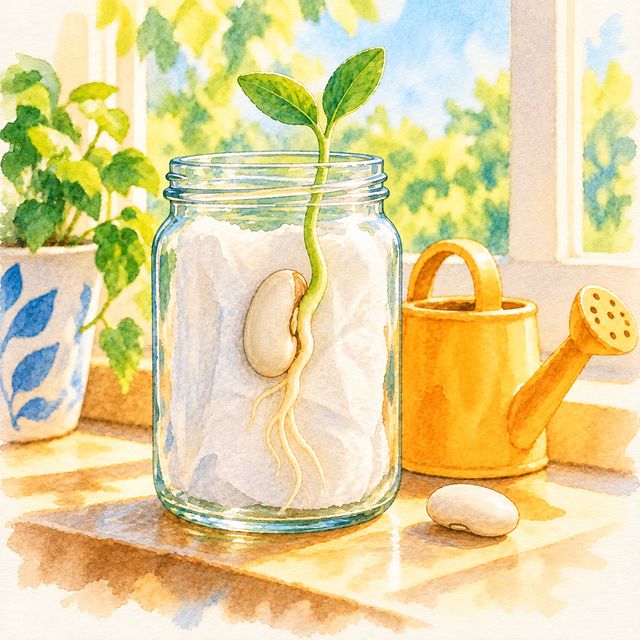
A bean your child grew, and their drawing of its root.
Your child presses a dried bean against the glass of a jar lined with damp paper, puts it by a window, and over a week or two watches a root, then a shoot and leaves.
- Pre-K to Grade 1–2
- 30 min
- A printout
- On the screen
Free to sign up.
Is it a good fit?
- Ready if Your child can wait a day for something to happen, with a reminder.
- Too much today? The Pre-K level: you soak the beans and line the jar; your child tucks them in and watches.
- Too easy? The 1–2 level: two drawings, days apart, compared.
What your child practises
- Looking closely
- Drawing what is there
- Noticing change over days
“The root grows down and the leaves grow up.”
If your child says something like this, in their own words, the idea has landed. Finishing the rounds means they took part; this is the learning.
Your part
- Find a clear jar and three big dried beans
- Line the jar at Pre-K
- Keep a finger of water in the bottom of the jar between sittings, and come back to it in a few days
What you need
From home
- A clear jar, plastic at Pre-K
- Kitchen paper
- Three big dried beans: runner or broad beans grow best (small parts)
- A cup of water
- A pencil and paper for the drawings
The steps
Pre-K
 Put the beans in a cup of water and leave them overnight, one night only. They drink and swell. (A grown-up does this step)
 Put the beans in a cup of water and leave them overnight, one night only. They drink and swell. (A grown-up does this step)
The other 5 steps, each with its painting, are in the Family portal.
It must pass: It grows a root you can see through the glass.
Kindergarten
- Put the beans in a cup of water and leave them overnight, one night only. They drink and swell.
The other 5 steps, each with its painting, are in the Family portal.
It must pass: It grows a root you can see, and you draw it.
Grade 1–2
- Put the beans in a cup of water and leave them overnight, one night only. They drink and swell.
The other 5 steps, each with its painting, are in the Family portal.
It must pass: It grows a root you can see, and you draw it twice, days apart, to show what grew.
Safety
The beans are for growing, not eating: raw dried beans are not safe to eat, so nobody eats these, and wash hands after handling them. Dried beans are small enough for a toddler to swallow, so keep the bag out of reach. Use a plastic jar at Pre-K. If the paper goes mouldy, throw the beans and paper away, wash the jar and start again with fresh paper.
Where the facts come from
More like this
The full design
What it is
A dried bean pressed between damp kitchen paper and the side of a clear jar, set on a windowsill, and watched for a week or two: first a root, then a shoot and leaves. Because the bean is against the glass, your child sees the part that is usually underground. The screen shows one step at a time as a painting of that step and asks at the end. The bean in the jar is the make.
How it goes
One step fills the screen: the painted plate of that step, the words under it, and two buttons. The steps fall into three short sittings with days between them: set up, the root, the leaves. Done this step moves on; skip it also moves on, and the finish says how many were skipped. At the end, Show asks what is true (a root came out, the root grows down), and What I learned asks the band's question.
The Pet
Asks at each step: "Look closely. Is there a root?" Notices: "A root. Your bean is alive." Remembers across the days: the make comes back at the step it stopped on, and the paused card says to keep the paper damp. It never hurries a bean.
By band
Pre-K: you soak the beans the night before and line the jar; your child tucks the beans in, watches for the root, draws it and looks for leaves. K: your child soaks the beans the night before and lines the jar too, and says which way the root grew. 1 to 2: the bean is drawn twice, days apart, and the two drawings side by side show what grew.
What it grows
A synthesis of 48 garden-learning studies found science gains in most of the studies that measured them, though the authors flag weak methods in many. Early learning frameworks name observing living things and describing change as science from age 3. So the claim here is small: your child looks closely, many times, at one living thing.
Done, and what counts as evidence
Done = the steps done or honestly skipped, and one line chosen at the end. The evidence is the bean, and the drawing of it, and at 1 to 2 the two drawings days apart: a record of change over time, which is what a scientist's notebook is.
What's personal
The drawings stay on your table; what your child answers is stored as their answer, not as a mark. Nothing about your home is stored. A material you do not have is named once, a substitute is offered, and the project carries on.