Reading · Pre-K to Grade 3–4
The clue board
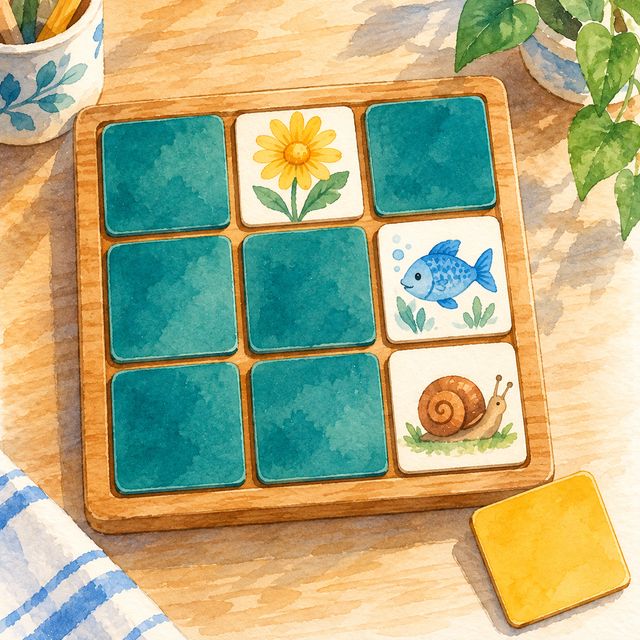
A quiz board of pictures from your child's storybooks, cleared together, with no points and no clock.
Pick a square, hear its riddle, tap the picture that fits. Take turns with the Pet, or with you, or with Grandma on your own call, until every square shows a picture.
- Pre-K to Grade 3–4
- 10 min
- Nothing to prepare
- On the screen
Free to sign up.
Is it a good fit?
- Ready if Your child can name a few animals and things from their books.
- Too much today? The Pre-K board: two columns, every riddle said aloud.
- Too easy? Grade 3–4: your child makes a riddle of their own and asks it of you.
What your child practises
- Describing things
- Listening for clues
- Using two clues at once (Grade 1 up)
- Reading a riddle aloud
“It lives on land, so not the fish!”
If your child says something like this, in their own words, the idea has landed. Finishing the rounds means they took part; this is the learning.
Your part
- Take a turn, beside them or on a call
- Answer aloud so your child can tap it for you
- Nothing to prepare
Take it off the screen (optional)
Play it at dinner with no screen: one person thinks of a thing, the others ask about where it lives, what it is and its sound.
More like this
The full design
What it is
A board of numbered squares in columns, each column headed by a kind of clue: Where I live, Alive or not, What I am, My first sound, My beats, My letters, My story. A tap on a square turns it into a riddle, "I live in the water. Which one am I?", and a few pictures from your family's storybooks to choose from. The one that fits clears the square, and the square shows its picture from then on. What it grows is describing a thing by its features, and from Grade 1, finding the one thing that fits two clues at once.
How it goes
The first screen asks who is playing: My Pet, Someone here or Someone on a call, and then who, by the name your family uses. Then turns, your child first. With the Pet, on its turn the Pet opens a square and says its answer, and your child checks it: That's right or Not yet. Once a board the Pet is wrong on purpose; your child says Not yet and finds the one that fits. With a grown-up beside them, or on your own call, on the grown-up's turn your child taps the square they pick, reads them the riddle (from Grade 1; Read it to me helps), and taps the picture they name. The Pet goes quiet while two people talk. The call is your family's own; MyEdora never carries it. A miss is "not yet": the picture fades and the square stays open. If nobody taps for a while the riddle is read again, a picture that does not fit fades, then another, and at the youngest ages the one that fits glows. The big clue: when every square is done, one riddle of two or three facts over the pictures on the board, answered together. Squares are never counted per player: the board is everyone's.
The Pet
Notices a careful answer: "You used both clues!" Asks the riddle again, one clue at a time, when your child is stuck. Remembers the book a picture comes from, when your child has finished it. Dares one harder riddle at the end, once.
By band
Pre-K: two columns from Where I live, Alive or not and What I am, two rows of three pictures; every riddle is said aloud and nothing is read. K: three columns, My beats among the choices (clap them), two rows of three, then four pictures. 1–2: three columns from all but My letters, three rows of three, four and five pictures; the third row asks two clues at once ("I live on land. I start like daisy."), each clue alone fits two of the pictures and only one fits both; the names are written under the pictures. 3–4: four columns, My letters always among them ("My word has five letters. My word starts with R."), three rows of four, five and six pictures; before the big clue, your riddle: your child picks one of six pictures and taps facts about it, the others fade as each fact rules them out until only theirs is left, and then they ask it of whoever is playing.
What it grows
Describing a thing by where it lives, what it is and how its name sounds is how vocabulary is taught by features. Finding the one thing that fits two rules at once is sorting by two criteria, which children take on from about six. Reading a riddle aloud to a listener is reading for a real reason.
Done, and what counts as evidence
Done = the board cleared and the big clue answered. Kept: that it was played, at which age, and the way (with the Pet, someone here, someone on a call). Not kept: who answered what, or any miss.
What's personal
The pictures come from the storybooks your family reads, and the turns are with your own people, by the names your family uses.