Math · Pre-K to Kindergarten
Sock sort
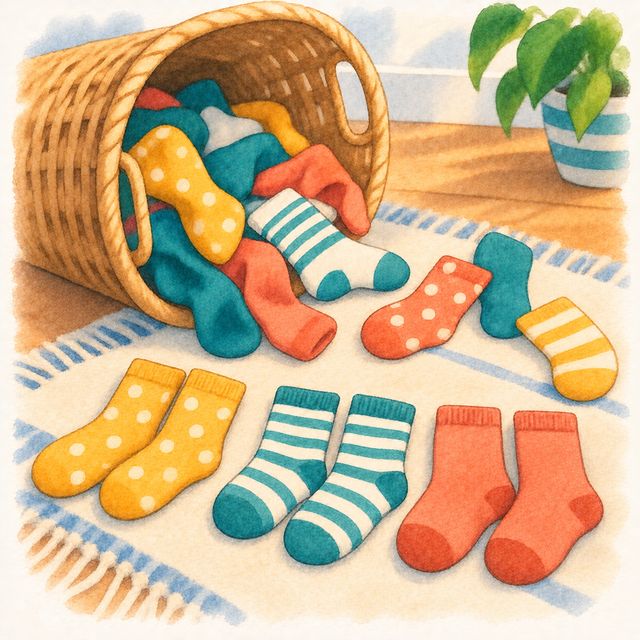
Your child makes a rule, keeps it, and counts the piles.
Your child sorts the real washing on the floor with you, by a rule like socks here and T-shirts there. On the screen they sort the Pet's washing the same way, compare the piles, and find the pairs.
- Pre-K to Kindergarten
- 10 min
- Kitchen things
- On the screen
Free to sign up.
Is it a good fit?
- Ready if Your child can tell a sock from a T-shirt and put like with like.
- Too much today? The Pre-K level: one rule, two piles, and which pile is bigger.
- Too easy? The Kindergarten level: sort by colour, find the pairs, a dot on the chart for each pair, and the sock with no friend.
What your child practises
- Sorting by a rule
- Which pile is bigger
- Pairs on a chart
“Socks here, T-shirts there. The socks pile is bigger.”
If your child says something like this, in their own words, the idea has landed. Finishing the rounds means they took part; this is the learning.
Your part
- A basket of clean washing on the floor
- Each question has a Read it to me button
- With you beside them: at this age the grown-up is part of the game
More like this
The full design
What it is
Tip the clean washing on the floor and sort it. That is the whole game: a rule ("socks here, T-shirts there"), piles that follow it, and a look at which pile is bigger. Later the same socks sorted a second way, pairs found, and a little chart of the pairs. This is the start of data: put things in groups, count the groups, say what you see.
How it goes
The Pet says the washing exploded and asks for help; your child sorts the real washing on the floor with you and taps "I did it". Then the screen checks the rule with its own washing: seven things at Pre-K, nine socks at K, tapped one at a time into their pile. A thing in the wrong pile is asked about, never marked: "is that a T-shirt? Look at the shape." Pre-K ends by tapping the bigger pile and hearing the counts. K goes on: two socks that match make a pair and a dot on the chart, until one sock is left alone. The odd sock is on the screen, and your child picks where its friend went: under the bed, still in the wash, or the Pet took it. Any answer is a good one. Tomorrow the socks lie in a new order and a different colour is the odd one.
The Pet
Asks: "a T-shirt. Which pile?" and "are those two the same?" Notices the sort done: "you made a rule and kept it." Dares (K): "bet you can sort them again. By size." Yes means the nine come back to the floor for a second sort, big socks and small socks.
By band
Pre-K: one rule, two piles, then "which pile is bigger?". K: sort by colour, find the pairs, put a dot on the chart for each pair, and one sock has no friend: where is it? The dare at K sorts the same socks again by size, big and small.
What it grows
Sorting by one attribute and then two, comparing groups and a first tally are the kindergarten measurement-and-data standard, and at four the rule is real objects, one idea, a grown-up beside. The habit this grows is the first move of every graph: put like with like, then count.
Done, and what counts as evidence
Done = one sort on the screen. The K chart is a small work sample; a photo of the real piles on the floor is the more honest one. What to keep: which rule your child chose for the real washing, and whether they saw the bigger pile without counting.
What's personal
The washing is yours, and the piles on the floor are the real work; the screen keeps its own drawn socks and stores nothing about your laundry. A grown-up beside the child is part of the game at this age, not a helper for it.