Math · Grades 5–6 and 7–8
Is it fair?
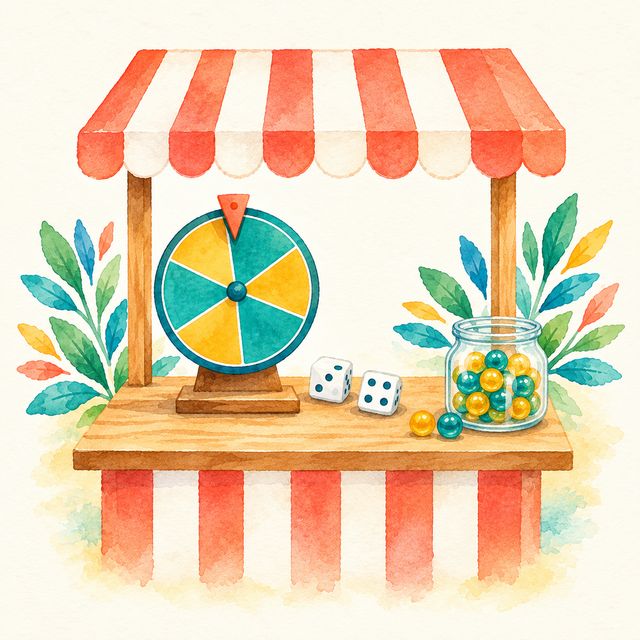
Your child learns to ask "out of how many?" before believing that something is fair or likely.
Your child checks the Pet's fair stall, where every game is said to be fair: which spinner gives the better chance, what an average means, and a bag of counters. At Grade 7–8 your child decides whether a dice is rigged, whether a two-dice game is fair, what a scatter graph shows, and who a survey speaks for.
- Grades 5–6 and 7–8
- 15 min
- Nothing to prepare
- On the screen
Free to sign up.
Is it a good fit?
- Ready if Your child can add a few numbers and share a total equally.
- Too much today? Start with The picture that fooled us: charts that trick the eye, before what the numbers mean.
- Too easy? The Grade 7–8 level: a rigged dice, the two-dice game, the dot that breaks the pattern, and who was asked.
What your child practises
- Chance as a fraction
- Mean and median
- Small samples and many trials (Grade 7–8)
- Scatter graphs and samples (Grade 7–8)
“Out of how many?”
If your child says something like this, in their own words, the idea has landed. Finishing the rounds means they took part; this is the learning.
Your part
- Nothing for the game itself
- Each question has a Read it to me button
- No money or betting is involved
Take it off the screen (optional)
Roll a dice 30 times together and tally it. Did every number come up exactly 5 times? What would 300 rolls show?
More like this
The full design
What it is
Out of how many? Skill: a chance as the winning parts out of all the equal parts; the mean and the median, and which one is typical; why a small sample wobbles; counting the ways a result can happen; a pattern in a scatter graph and the one dot that breaks it; who a sample speaks for.
How it goes
The Pet's claim sits under the picture. Your child taps a spinner or a dot, or chooses from three. Every miss has its own reason, with the numbers worked out.
The Pet
It runs the stall and believes something its own numbers do not show, never your child: "My average is 4, so I usually score 4!" When a round is answered it says what the numbers showed. Its dare is the next step up: at 5–6, whether a dice is rigged; at the top, roll a dice 30 times, tally it, and see whether every number came up exactly 5 times.
By band
One stall, a different thing on it each round. 5–6: tap the spinner with more chance of marigold (B, 2 parts in 6, against A, 1 in 4); the mean of five throws, 2, 5, 3, 6 and 4 (4, and the bars level to it); the typical throw of 1, 12, 2, 3 and 2 (the median, 2: the mean, 4, was never thrown); the chance of a marigold counter from a bag of 3 marigold and 5 lagoon (3 in 8). 7–8: a dice that came up six 14 times in 60 (not proven: a fair dice does that about 1 time in 9); "you win on 2, the Pet on 7" with two dice (not fair: 7 six ways, 2 one, of 36, the grid lit); tap the dot that breaks the pattern on a graph of practice against score; 9 of 10 people asked at a pool said swimming (that speaks for people at the pool).
What it grows
The Common Core asks a Grade 6 child to summarise data with a mean and a median and say which describes it better (6.SP.B.5), a Grade 7 child to find probabilities, compare them with what happens over many trials and see that a small sample can mislead (7.SP.C.5–7, 7.SP.A.1), and a Grade 8 child to read a pattern and an outlier in a scatter plot (8.SP.A.1); England's national curriculum asks for the mean in Year 6 and for probability in Key Stage 3. Every number on the screen is worked out in the game's test before it is said.
Done, and what counts as evidence
Done means the four rounds answered. "Out of how many?" and "60 rolls is not enough to tell" are observations you may keep. The best record is off the screen: your child's own tally of 30 rolls, and what they make of it.
What's personal
Nothing. Every number is the game's own; nothing about your child or the family is asked or kept.