Science · Pre-K to Kindergarten
Sort the zoo
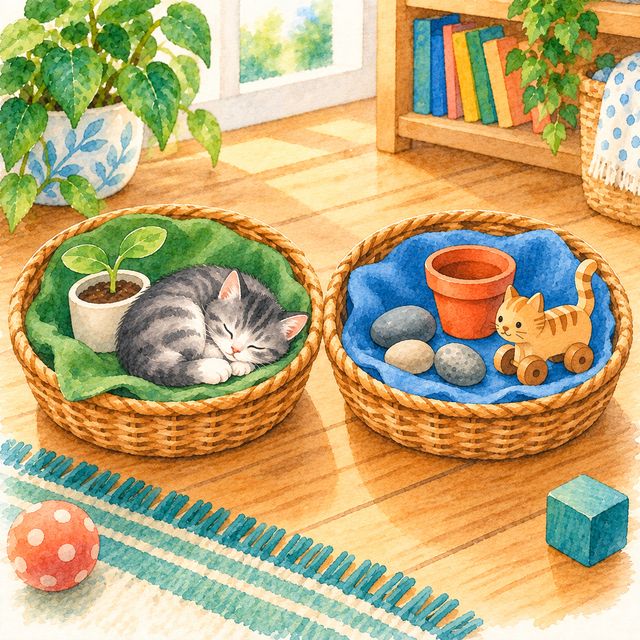
Your child sorts the things from their own storybooks: alive or not, then animal or plant.
One picture at a time and two baskets, each with a picture of its own. Your child taps the basket it belongs in; a wrong basket gets a question about what to look at. Then your child sorts real things around them.
- Pre-K to Kindergarten
- 10 min
- Nothing to prepare
- On the screen
Free to sign up.
Is it a good fit?
- Ready if Your child can name most of the pictures in a book they have read.
- Too much today? Start with Pet, or wild?: one animal at a time, with people or wild.
- Too easy? The K level: animal, or plant, once your storybooks hold enough plants.
What your child practises
- Telling living from not living
- Looking closely
- Saying how you know
“The stone is not alive, it never eats.”
If your child says something like this, in their own words, the idea has landed. Finishing the rounds means they took part; this is the learning.
Your part
- Say which rooms or windows are fine for the real sort
- Ask "how do you know?"
Take it off the screen (optional)
On a walk, point at things and ask: alive, or not? Then the hard ones: a leaf on the ground, a cloud.
More like this
The full design
What it is
What kind of animal is that? Your child sorts by what they can see: alive or not, animal or plant, then fur, feathers, scales, a shell, wet skin, six legs, and later the names for the groups (mammal, bird, fish, reptile, amphibian, insect) with the animals that break the rule: a bat that flies, a penguin that does not, a whale in the sea, a platypus that lays eggs. At the top the question turns round: why does this body fit this place? The mechanic is Which one doesn't belong?'s: a set, a tap, and a reason.
How it goes
Four things stand in a row and the Pet asks the round's question ("which ones are alive?", "what is on the outside?"); the bins carry a picture each (a tuft of fur, a feather, a scale, a shell, a drop of water, six legs) so a child who cannot read yet can tell them apart, and a tap on any animal opens it big enough to see its skin; every animal in the deck fits one bin plainly (the beetle's hard back is a pair of wings, and the Pet says so if the shell bin is tapped). A tap into the wrong bin says what to look at ("look at the wings; feathers, or skin?") and waits. At 3–4 the odd one has two bins that are both half right and the Pet asks which rule wins (milk and fur make a mammal, even with wings), then says the line. At 5–6 the animal stands in its place (the desert, the ice) and the claim is built from three chips: the part, the place, the because. Stuck, the simpler step is an animal not yet sorted, never one already binned. Then the real sort: the toy animals on the floor, into the same groups, and the screen waits until "we sorted them" is tapped. The finish says how many were sorted and names the one that broke a rule.
The Pet
Asks: "fur, or feathers? Touch the picture." Notices: "a bat. Fur and wings. Milk for its babies." Remembers only a real earlier play: "the penguin fooled us last time. Which bin now?" Dares (K): "bet you can find the one with a shell"; (1–2): "bet you can find the bird that cannot fly"; (3–4): "bet you can say why a camel has wide feet"; (5–6): "bet you can say why a cat's body fits a house." At the floor sort it never says what the child sorted: "I cannot see your floor. Tell me."
By band
Pre-K: alive or not (a cat, a stone, a tree, a toy car), tapped into two bins; the toy cat gets its honest answer (a toy, not alive, though it looks like one). K: animal or plant, six things. 1–2: what is on the outside: fur, feathers, scales, a shell, wet skin, six legs; one animal at a time into six bins with a picture each. 3–4: the group names, and the odd ones out: a bat has fur and feeds its young milk, so it is a mammal that flies; a penguin has feathers and lays eggs, a bird that swims; a whale and a dolphin breathe air and feed milk, mammals in the sea; a platypus lays eggs and is still a mammal (fur, milk). 5–6: why the body fits the place, said as a claim with the evidence: the camel's wide feet on sand and its hump of fat for the weeks without food; the penguin's tight feathers and fat against the cold; the sloth's slow life on little food; the hedgehog's spines.
What it grows
Sorting by a rule you can see is the first classification children do, and the groups with names come after, once there are enough animals to need them. The animals that break a rule are the point of the game, not a trap: a child who can say why a whale is not a fish has understood what the groups are for. The claim with evidence at the top is the shape of every science sentence after it.
Done, and what counts as evidence
Done means the things sorted at the rung and the floor sort done. At 3–4 the odd one out with the rule that wins is the observation worth a line ("said a bat is a mammal because of fur and milk"); at 5–6 the claim with its because. Nothing is written at Pre-K or K.
What's personal
The animals on the screen are the ones the atlas already knows, plus a few added for this game (the bat, the whale, the dolphin, a fish, a frog, a snail, a beetle); the family pet, if a grown-up shared its kind, is the last animal at 1–2 and is sorted like any other. The real sort is your toy box, in your child's hands, and the app never sees it or marks it. Nothing is stored.